Shopping Center & Retail LED Lighting in Plano, TX: Storefronts, Sales Floors, Parking & Center-Wide Upgrades
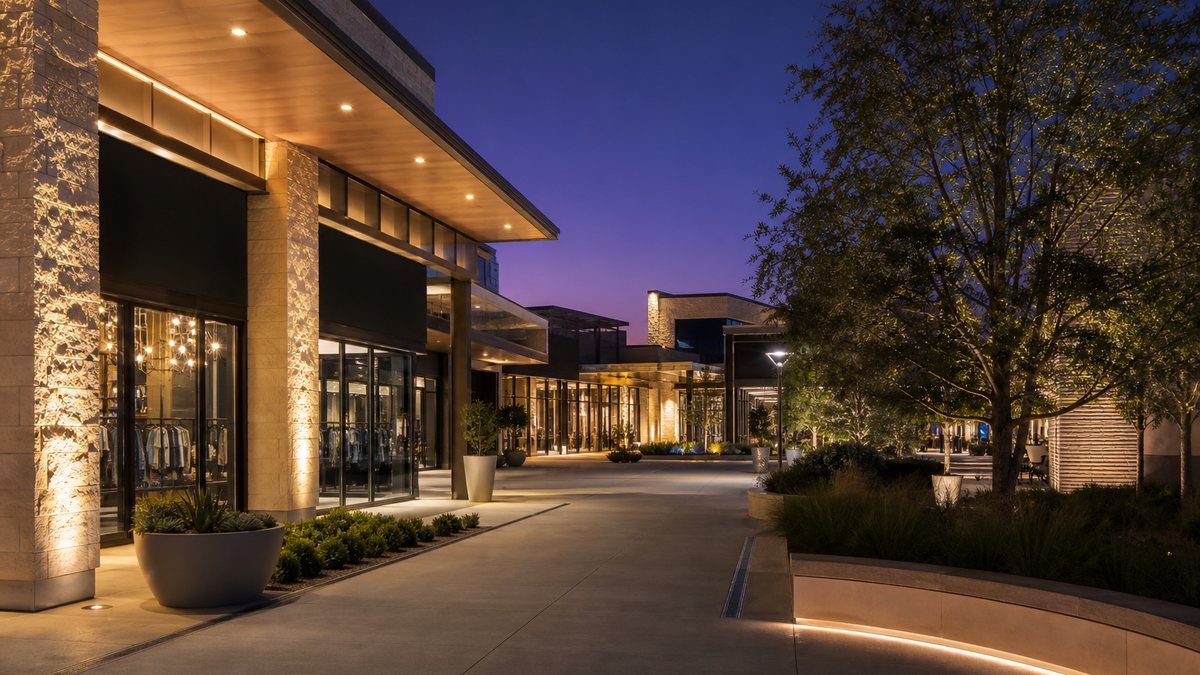
Shopping center and retail LED lighting in Plano does more work than almost any other lighting in the city. It has to make merchandise look right, pull drivers off the Dallas North Tollway and US-75, keep parking lots and walkways safe after dark, and do it all while running long hours, often seven days a week. Plano shoppers have an unusual amount of choice, from mixed-use destinations around Legacy to neighborhood centers along Preston Road, Park Boulevard and Coit Road, and lighting is one of the quiet reasons a center feels inviting or tired.
This guide is for shopping center owners, property managers, retail tenants and restaurant operators in Plano and Collin County. It covers what good retail lighting looks like, how to light sales floors, storefronts, canopies and parking, how lighting controls cut energy and simplify management, how to plan a center-wide upgrade without closing stores, and what to ask before you hire a lighting contractor.
Shopping center and retail LED lighting combines high-color-quality interior lighting, bright and consistent storefronts, well-lit canopies and walkways, and efficient parking lot lighting, all tied together with controls.
- Sales floors: high-CRI LED (90+ for most retail, higher for fashion, jewelry and cosmetics)
- Displays: adjustable track and accent lighting with a clear contrast between feature and ambient light
- Storefronts and canopies: even, glare-free light that makes every tenant look open and consistent
- Parking and walkways: full-cutoff LED area lights that improve uniformity and reduce dark spots
- Controls: schedules, photocells, dimming and occupancy sensors for back-of-house
- Phasing: after-hours, tenant-by-tenant installation so stores stay open
- Pricing: quoted per property after a site walkthrough
Why lighting matters so much for Plano retail
Retail lighting is not only about seeing. It shapes how customers judge a store before they step inside, how long they stay and how products look in their hands. For shopping centers it also affects safety, security and how the whole property is perceived from the road.
- First impressions from the road: a bright, even storefront line and lit signage tell drivers a center is open and well run.
- Merchandise appearance: color quality decides whether fabric, food, cosmetics and finishes look true or washed out.
- Dwell time: comfortable, layered light makes customers more willing to browse and linger.
- Safety and security: uniform parking and walkway light reduces trip hazards and supports camera coverage.
- Tenant attraction and retention: a center with dark sections or mismatched color looks neglected, which affects leasing.
- Operating costs: long operating hours make efficient LED and controls one of the most practical property upgrades.
Plano's retail market is also changing. Mixed-use districts around Legacy combine shopping, dining, offices and residences, and the redevelopment of the former Collin Creek Mall site is turning an enclosed mall into a mixed-use neighborhood. Older strip and neighborhood centers compete with those newer destinations, and lighting is one of the most visible, cost-effective ways to close the gap.
The layers of retail lighting
Good retail lighting is built in layers. Each one has a job, and the balance between them is what makes a store feel premium instead of flat.
Ambient (general) lighting
Ambient light sets the overall brightness so customers can move through the space comfortably. In most stores this comes from LED troffers, linear fixtures or downlights. The goal is even coverage without glare, at a level that suits the brand: a discount or grocery format usually wants bright, uniform light, while a boutique uses lower ambient light so displays stand out.
Accent lighting
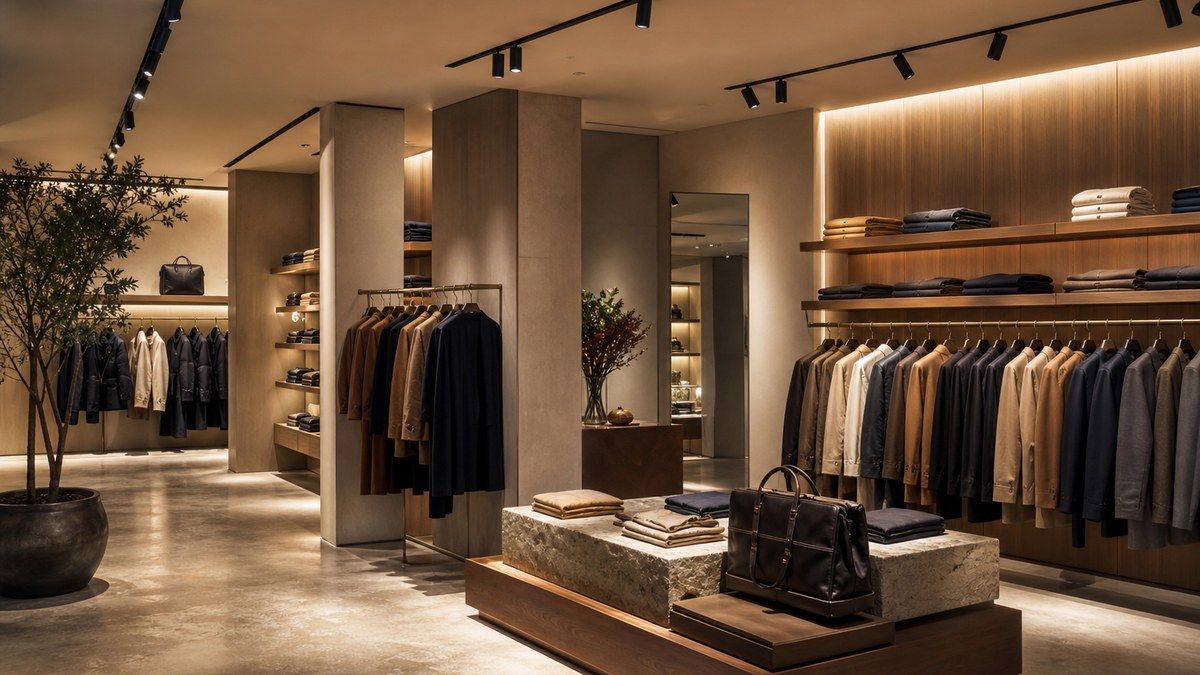
Accent light draws the eye to products, displays and focal walls. Track heads and adjustable recessed fixtures let merchandisers re-aim light every time the floor changes. A common rule of thumb in retail design is that featured merchandise should be noticeably brighter than its surroundings, so customers see a clear hierarchy instead of a uniform wash.
Task lighting
Checkout counters, service desks, fitting rooms, pharmacy counters and food prep areas need focused, comfortable light so staff can work accurately and customers can see what they are buying.
Decorative and architectural lighting
Pendants, cove lighting, illuminated shelving and lit architectural features give a store personality. In restaurants and higher-end retail this layer carries much of the brand experience.
Perimeter and wall lighting
Lighting the walls makes a space feel larger and pulls customers toward the back of the store. Wall washers and linear fixtures along shelving keep perimeter merchandise from falling into shadow.
Color quality: CRI, TM-30 and color temperature
Color quality is where retail lighting differs most from office or warehouse lighting. Customers judge products by color, and poor color rendering is one of the most common reasons merchandise looks cheap under older or low-cost LED fixtures.
- CRI (Color Rendering Index): a 0–100 measure of how naturally a light source shows colors. Most retail benefits from 90+ CRI; fashion, jewelry, cosmetics, art and fresh food often justify the highest-rendering fixtures available.
- R9 (saturated red): a separate value worth checking. Fixtures with weak R9 make skin tones, meat, produce and red fabrics look dull.
- TM-30: a newer metric that shows fidelity and saturation in more detail than CRI, useful when comparing premium fixtures.
- Color consistency: fixtures should come from tight color bins so a row of downlights or a storefront line does not show mismatched tints.
| Space or product | Typical color temperature | Why |
|---|---|---|
| Fashion and apparel | 3000K–3500K | Flattering skin tones, warm and welcoming |
| Jewelry and watches | 3000K–4000K with sparkle accents | Warm for gold, cooler for diamonds and silver |
| Electronics and tech | 4000K | Crisp, modern, clean contrast |
| Grocery and fresh food | 3000K–4000K by department | True color for produce, meat and bakery |
| Restaurants and cafés | 2700K–3000K | Warm, relaxed dining atmosphere |
| Home goods and furniture | 3000K | Residential feel so shoppers picture items at home |
| Back-of-house and stockrooms | 4000K | Clear, functional work light |
These are starting points, not rules. Brand standards, finishes and window daylight all affect the final choice, which is why a mockup of a few fixtures before a full rollout is often worth the time.
Storefronts, facades and canopies
For a shopping center, the storefront line is the face of the property. Drivers on Preston Road, the Tollway or Spring Creek Parkway see it before they see any single tenant. Common problems in older Plano centers include uneven canopy lights, burned-out soffit fixtures, a mix of warm and cool sources, and glare that makes signs harder to read.
- Canopy and soffit downlights: consistent color temperature and output across every bay so the center reads as one property.
- Facade grazing and washing: lights architectural features such as stone, columns and towers to give the center depth at night.
- Entry lighting: brighter, welcoming light at entrances helps customers find the door and feel safe.
- Sign compatibility: facade and canopy light should support, not compete with, tenant signage. Our partners at American LED Signage handle channel letters, monument signs and message centers.
- Seasonal and color-changing accents: RGBW architectural lighting on DMX or networked controls lets a center mark holidays and events without new fixtures.
Parking lots, walkways and site lighting
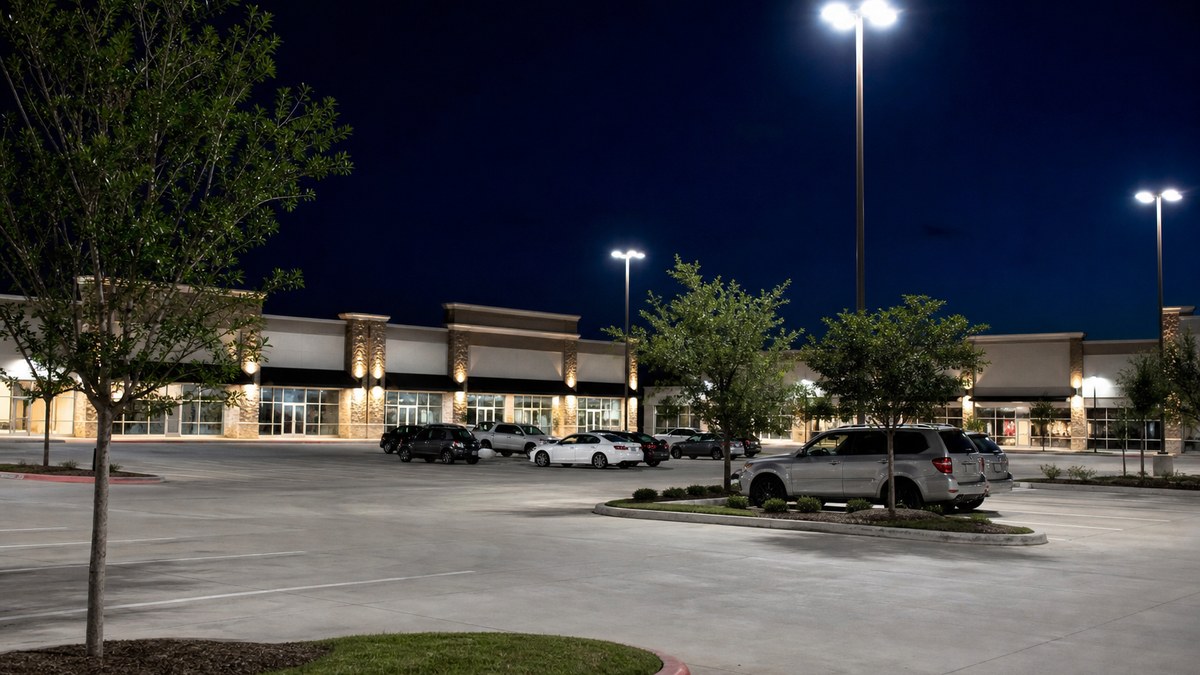
Customers decide how safe a center feels the moment they park. Older metal halide and high-pressure sodium poles often create bright pools with dark gaps between them, take minutes to restart after an outage, and fade and shift color with age.
Modern LED area lighting improves the experience in several ways:
- Better uniformity: optics designed for parking layouts spread light more evenly, reducing dark spots between poles.
- Full-cutoff fixtures: keep light on the lot and off neighboring homes and the night sky, which matters where centers back onto residential streets.
- Instant on: no warm-up delay after a power blip.
- Controls: photocells and schedules turn lots on at dusk and allow dimming after closing while keeping security levels.
- Less maintenance: far fewer lift trips to replace lamps on tall poles.
Walkways, breezeways, loading areas and service corridors deserve the same attention. They are where employees walk to their cars after closing, and where poor lighting creates the most risk.
Planning a retail lighting upgrade in Plano?
Tell us about your center or store and we will follow up to schedule a walkthrough and a project-specific proposal.
Lighting by retail format
Neighborhood and strip centers
The biggest wins are usually outside: canopy and soffit lights, parking poles and building-mounted wall packs. Making the whole storefront line consistent gives an older center a noticeably fresher look, and it can be done without entering any tenant space.
Lifestyle and mixed-use districts
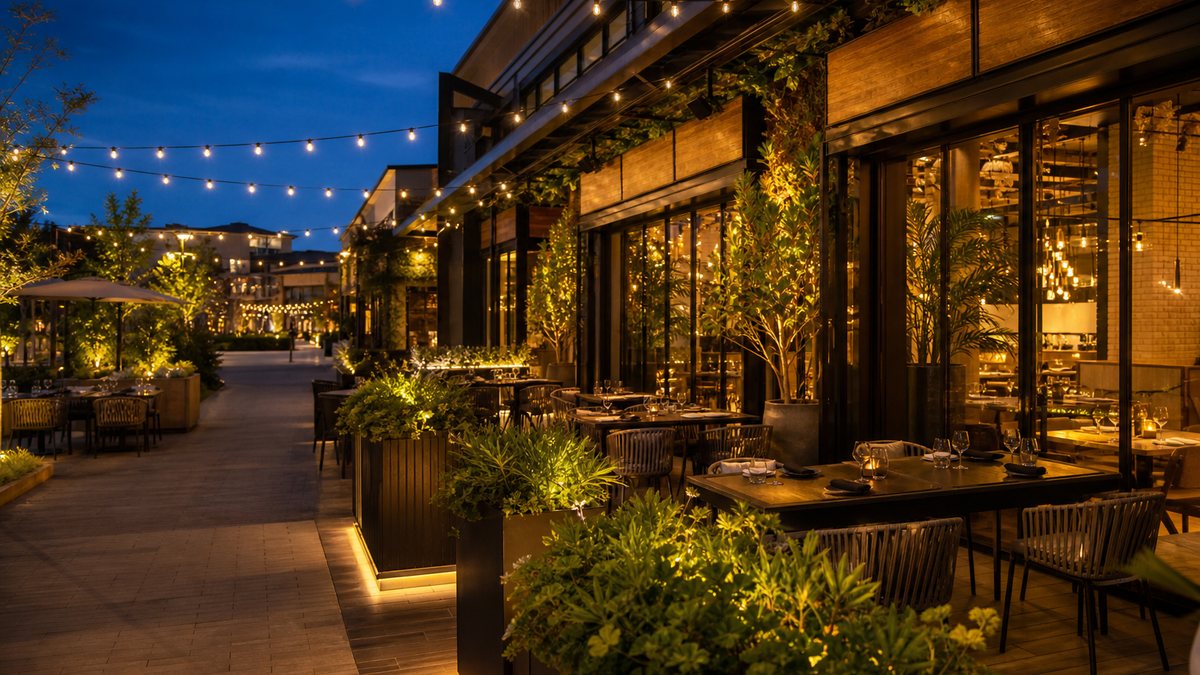
Open-air centers depend on the outdoor experience: lit walkways, landscape and tree lighting, string and festoon lighting over plazas, water features and patio dining. Layered, warm exterior lighting keeps people outside longer in the evening. For fountains and signature features, our network offers 360° laser fiber optic lighting.
Big-box and grocery
High ceilings call for LED high-bay or linear fixtures with good optical control. Grocery adds department-specific needs: refrigerated case lighting, produce and bakery accent light, and very long operating hours that make efficiency and controls especially valuable.
Boutiques, salons and specialty retail
Smaller stores win with contrast: lower ambient light, carefully aimed accent light, flattering fitting room and mirror lighting, and fixtures with excellent color rendering. A few well-chosen fixtures often do more than a ceiling full of panels.
Restaurants, cafés and food halls
Dining spaces need warm, dimmable light that shifts from bright lunch service to a relaxed evening mood, plus durable patio lighting. Scene controls make it one-touch for staff. For bars and lounges looking for a signature effect, fiber optic starlight ceilings are a distinctive option.
Medical, dental and service tenants
Many Plano centers lease to clinics, dentists and service businesses. These spaces need flicker-free, high-CRI lighting and comfortable waiting areas, which overlap closely with good retail practice.
Lighting controls for retail properties
LED fixtures save energy on their own, but controls decide how much. In retail, controls also make it easier to manage many tenants and long hours.
| Control | Where it fits | What it does |
|---|---|---|
| Astronomical time clocks | Parking, canopies, facades, signs | Turn lights on and off with sunset and sunrise automatically |
| Photocells | Exterior lighting | Respond to actual daylight and storms |
| Scheduled dimming | Parking and site lighting after closing | Lower output overnight while keeping security light |
| Occupancy sensors | Stockrooms, restrooms, offices, corridors | Lights run only when someone is there |
| Daylight harvesting | Storefront zones near windows and skylights | Dims fixtures when daylight is sufficient |
| Scene control | Restaurants, showrooms, events | One-touch settings for different times of day |
| Networked control | Center-wide or multi-site portfolios | Central scheduling, monitoring and fault reporting |
Commercial energy codes also require many of these controls on new installations and major alterations. Requirements depend on the code edition the City of Plano enforces and the scope of work, so confirm them during design. We cover the topic in more depth in our Plano commercial LED guide.
Planning a center-wide upgrade without closing stores
The biggest concern for owners and tenants is disruption. A well-planned retail lighting project keeps every store open.
- Night walkthrough and inventory: document every fixture type, wattage, color and failure, inside common areas and outside.
- Goals and standards: agree on color temperature, light levels and fixture appearance so the whole center matches.
- Mockup: install a few sample fixtures on one bay or one store so owners and tenants see the result first.
- Proposal and phasing: a project-specific proposal that breaks the work into exterior, common area and tenant phases.
- Incentive check: many commercial LED upgrades in the Oncor service area may qualify for energy-efficiency incentive programs, depending on the project and current program availability; most programs require approval before work starts.
- After-hours installation: exterior work at night or early morning; interior work after closing, one tenant at a time.
- Commissioning: program schedules, photocells and dimming, then verify at night.
- Documentation and service: fixture schedules, warranty information and a maintenance plan so the center stays consistent.
Owner vs tenant: who lights what?
In most shopping centers, responsibility is split by the lease:
- Owner / landlord: parking lots, site and pole lighting, canopies and soffits, common walkways, facade and architectural lighting, and pylon or monument signs.
- Tenant: interior sales floor, display, back-of-house and storefront window lighting, plus their own building signs.
Coordinating both sides pays off. When an owner upgrades exterior lighting, offering tenants the same contractor and fixture standards keeps the center consistent and simplifies scheduling. We work with property managers, tenants, brokers and general contractors on both sides of the lease.
What drives the cost of retail lighting projects
Every center and store is different, so we price each project individually after a walkthrough. The main factors are:
- Scope: exterior only, common areas, one tenant, or the whole property
- Retrofit vs new fixtures: reusing poles, housings and wiring versus replacing them
- Fixture quality: color rendering, optics and finish
- Controls: basic time clocks through networked systems
- Access: pole heights, lifts, canopy construction and traffic control in parking lots
- Electrical condition: aging circuits, underground wiring and code items
- Schedule: night and phased work around trading hours
You receive a written, project-specific proposal before work begins. For sourcing, our network also includes wholesale LED components.
Questions to ask before you hire
- Will you do a night walkthrough of the property?
- What CRI, R9 and color consistency do the specified fixtures have?
- Can we see a mockup before the full rollout?
- How will installation be phased around store hours?
- What controls are included, and who programs them?
- Which fixtures and drivers are specified, and what warranties do they carry?
- Who handles service after the project is finished?
Plano LED Lights brings 15+ years as an authorized architectural lighting dealer and project coordinator. Our licensed installation partner has completed over 200 major sports and commercial projects across the US and Canada, and we handle design, supply, installation, programming and service with one accountable team. Learn more on our retail lighting services page or about full design-build projects through the Luminance program.
Frequently Asked Questions
What is the best lighting for a retail store?
What CRI should retail lighting have?
What color temperature is best for retail?
Can a shopping center upgrade its lighting without closing stores?
Who pays for lighting in a shopping center, the owner or the tenant?
Is LED parking lot lighting worth upgrading?
Do retail lighting upgrades qualify for incentives in Plano?
How much does shopping center lighting cost?
Do you work with property managers and tenants?
What areas do you serve?
Make your center shine after dark
Request a consultation and we will follow up to schedule a night walkthrough of your property.
Related
Our DFW lighting network: Dallas commercial LED lighting, Fort Worth LED lighting, Arlington LED lighting, Irving LED lighting, statewide Texas LED lighting, wholesale LED components, fiber optic starlight ceilings, 360° fiber optic lighting, premium pool lighting, modular building solutions, and Dallas modular structures.