Corporate Campus Lighting in Legacy & Granite Park, Plano: Corporate Lighting Solutions for Lobbies, Offices, Garages & Grounds
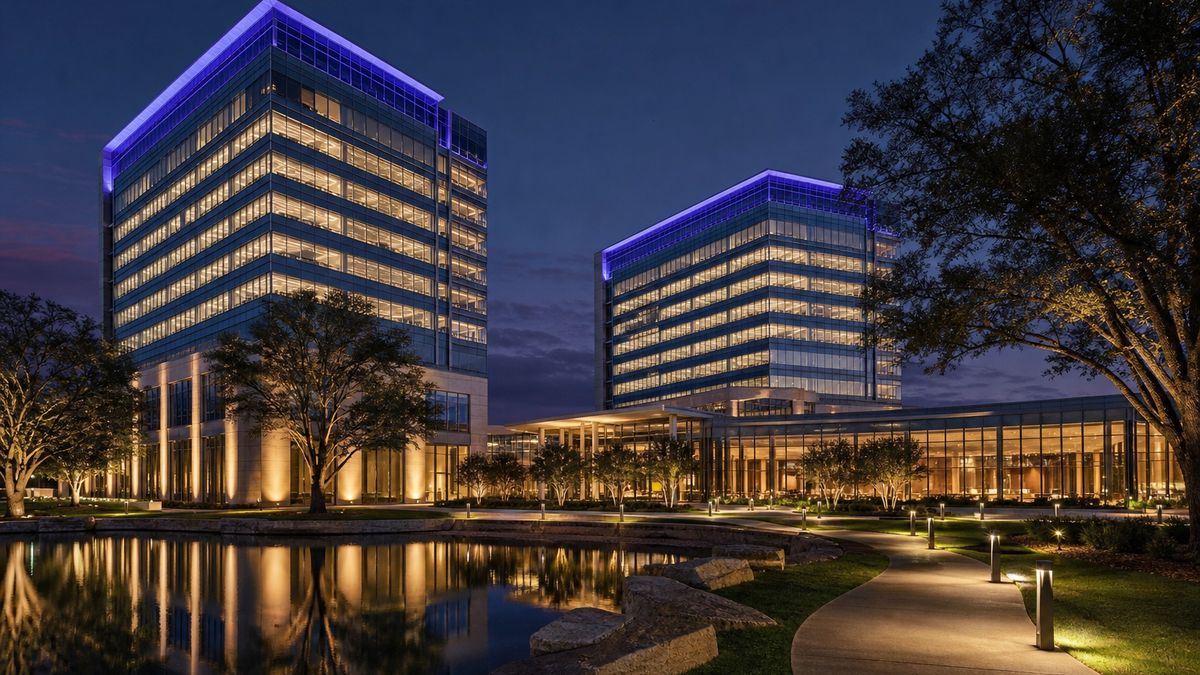
Corporate lighting solutions in Plano have a bigger job than lighting a single office suite. A corporate campus in Legacy, Legacy West or Granite Park is a small city: glass towers and low-rise buildings, a front-door lobby that represents the company, open offices and private offices, meeting rooms and training centers, cafés and fitness rooms, multilevel parking garages, surface lots, walking paths, ponds, plazas and monument signs. Every one of those spaces runs on a different schedule and needs a different kind of light, yet the whole property has to feel like one brand after dark.
This guide is for facility directors, corporate real estate teams, property managers and building owners in Plano and Collin County. It walks through how to plan lighting across an entire campus, what each zone needs, how campus-wide controls tie it together, how to upgrade occupied buildings without disrupting work, and how to choose a partner who can manage design, supply, installation and programming as one coordinated project.
Corporate campus lighting is a coordinated plan that covers every building and outdoor zone on a property, built around consistent color, glare control, comfort for employees and networked controls that the facility team can manage from one place.
- Lobbies and arrival: layered architectural lighting that reflects the brand and stays comfortable all day
- Workspaces: low-glare, flicker-free LED with daylight-responsive dimming and occupancy sensing
- Meeting and training rooms: scene control and camera-friendly light for video calls
- Garages and surface lots: even, high-uniformity LED with sensors and instant restart
- Grounds and facades: path, landscape, plaza and architectural lighting on schedules
- Controls: one networked system with schedules, zones and reporting across buildings
- Pricing: a project-specific proposal after a campus walkthrough
Why campus lighting is different from office lighting
Most lighting projects focus on one space at a time. A campus needs a different approach because the problems show up between buildings and between zones, not only inside them. When campuses grow in phases, it is common to find one building with warm 3000K downlights, a newer one at 4000K, a garage still running older fixtures and walkways lit by whatever was specified years ago. Each choice made sense at the time, but together they make the property look inconsistent and are harder to maintain.
- Brand and first impression: visitors, recruits and clients judge a company by its arrival experience, from the entry drive to the lobby.
- Employee comfort and return-to-office: glare, flicker and dim corners make offices less pleasant places to work, which matters when companies want people on site.
- Safety and security: garages, parking lots, paths and building entries are used early in the morning and late at night.
- Operations at scale: many fixture types and many different control systems mean more spare parts, more service calls and more programming to manage.
- Energy and code: large properties with long operating hours benefit most from efficient LED and controls, and new work has to meet the energy code edition the City of Plano enforces.
- Sustainability reporting: many corporate owners track building energy, and lighting is one of the clearest systems to measure and improve.
Start with a campus lighting master plan
The most valuable step in any campus project happens before a single fixture is ordered. A lighting master plan sets standards for the whole property so every future renovation, tenant improvement or repair follows the same rules.
A good master plan usually defines:
- Color temperature by zone: for example, warmer light in lobbies, dining and hospitality areas, and neutral white in offices, labs and garages.
- Color quality: a minimum CRI and color consistency requirement so fixtures from different phases still match.
- Approved fixture families: a short list of downlights, linear fixtures, area lights and path lights to simplify spares and service.
- Control standards: one control platform, naming conventions for zones and a standard sequence of operation.
- Exterior rules: full-cutoff optics, glare limits near roads and neighbors, and schedules for facades and signs.
- Phasing roadmap: which buildings and zones get upgraded first, based on condition, visibility and operating hours.
For a full design-build approach, our Luminance program covers concept, design, supply, installation and commissioning under one plan.
Lobbies, atriums and arrival
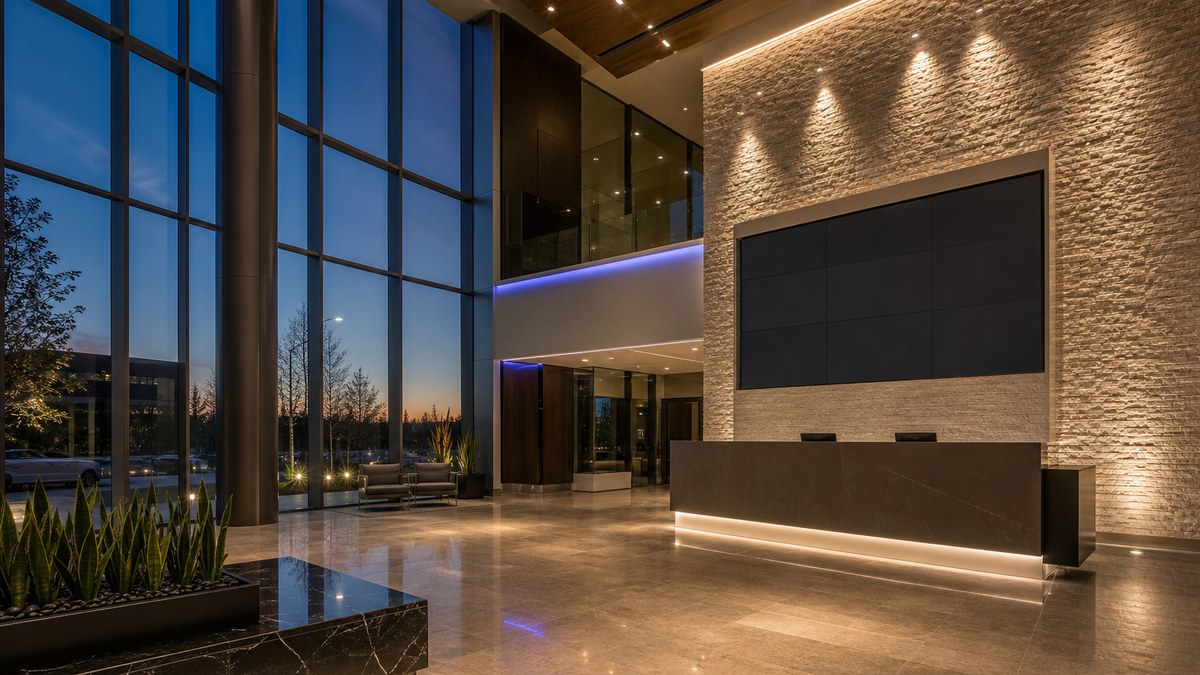
The lobby is the most visible lighting on a corporate campus. It needs to impress visitors, guide them to security and reception, and still be comfortable for employees who walk through it every day. Tall atriums with glass walls add a challenge: the space is flooded with Texas sun during the day and becomes a dark volume at night unless it is lit carefully.
What works in corporate lobbies
- Layered light: ambient downlights, cove and linear accents, wall washing on stone or wood, and accent light on art, logos and feature walls.
- Vertical illumination: lit walls and faces make a space feel bright and welcoming, more than simply adding light to the floor.
- Reception and security desks: focused task light and soft front light so staff and visitors can see faces clearly.
- Daylight balancing: photosensors that raise interior light at dusk and lower it on bright afternoons keep the lobby looking consistent.
- Media and video walls: many corporate lobbies use an LED video wall for brand content and visitor information. See our LED video wall services.
- Signature features: lit staircases, suspended linear sculptures or a fiber optic ceiling in an executive lounge. Our network partner offers fiber optic starlight ceilings for statement spaces.
Open offices, private offices and collaboration space
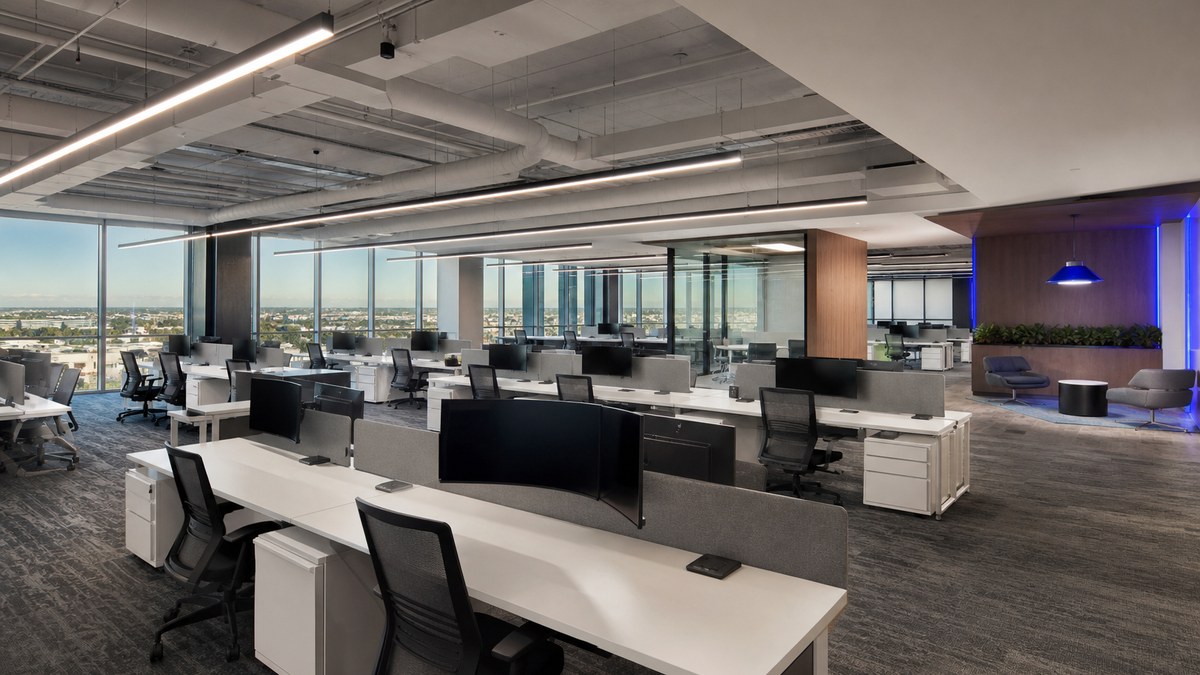
Workspace lighting has the largest impact on how employees experience the campus. Modern offices mix open desks, focus rooms, private offices and lounges, and each needs light that is comfortable on screens and on faces.
- Low glare: fixtures with good optical control or indirect/direct distribution reduce reflections on monitors.
- Flicker-free drivers: quality LED drivers avoid visible and camera-visible flicker, especially when dimmed.
- Tunable white where it helps: some workplaces use fixtures that shift color temperature through the day; it adds cost and complexity, so it is worth piloting first.
- Daylight zones: perimeter rows near glass dim automatically when daylight is available.
- Occupancy and vacancy sensing: private offices, focus rooms, restrooms and storage turn off when empty.
- Personal control: simple wall or app control lets people adjust light in their own space.
We cover sensors, daylight dimming and networked systems in detail in our guide to office lighting controls in Plano and DFW.
Meeting rooms, training centers and auditoriums
Corporate campuses often include boardrooms, huddle rooms, training rooms, town hall spaces and auditoriums. These rooms are increasingly used for hybrid meetings, so lighting has to work for the people in the room and for the camera.
- Even facial light: soft light on faces without harsh shadows or hot spots on the table.
- Presentation scenes: one-touch scenes for meetings, video calls, presentations and cleaning.
- AV integration: lighting controls that work with the room's AV system or touch panel.
- Auditorium and town hall lighting: house lights, stage wash and accent lighting, plus dimming that does not flicker on camera.
Our meeting and conference room lighting guide goes room by room.
Amenity spaces: cafés, fitness and lounges
Campus amenities are part of how companies attract and keep employees. Each one has its own lighting character:
- Cafés and dining: warm, dimmable lighting with pendants and accent light on servery counters, shifting from bright breakfast service to softer evening events.
- Fitness centers: bright, even light with good vertical illumination and fixtures that avoid glare for people on floor equipment.
- Lounges and libraries: residential-style warm light with table and floor lamps or decorative fixtures.
- Outdoor terraces: durable, wet-rated fixtures and string or festoon lighting that extends use into the evening.
Planning a campus lighting upgrade in Legacy or Granite Park?
Tell us about your property and we will follow up to schedule a day and night walkthrough and a project-specific proposal.
Parking garages and surface lots
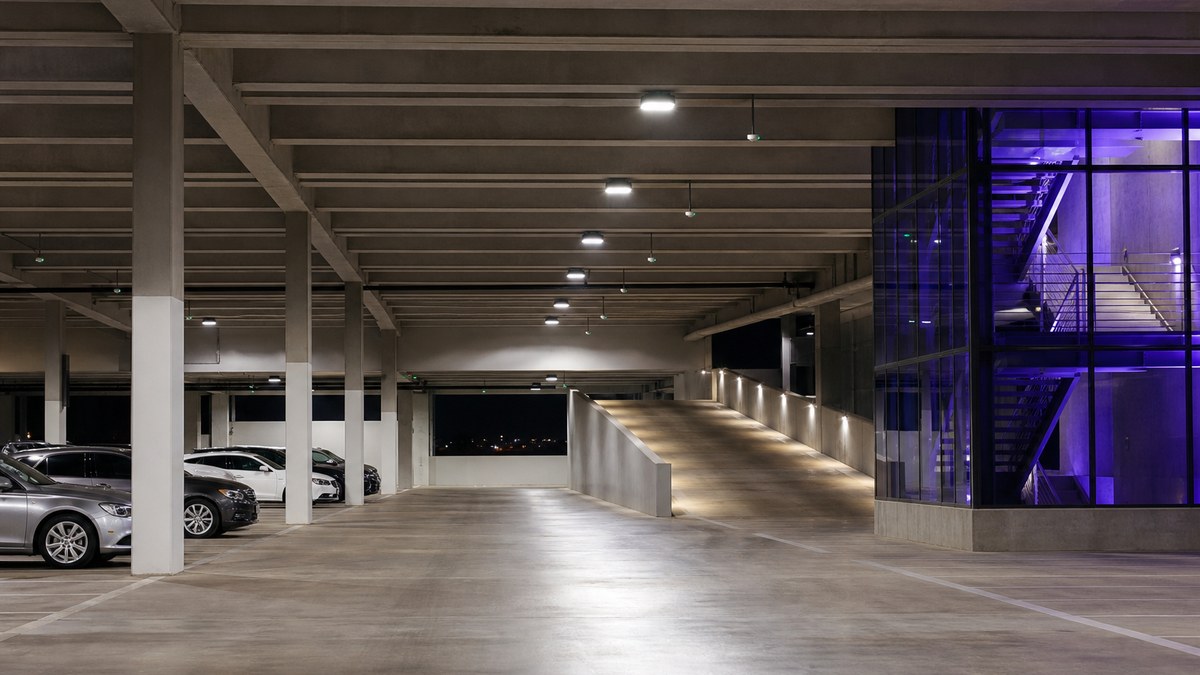
On many corporate campuses, parking is where lighting runs the longest hours and where employees feel most exposed. Garages are often lit around the clock, and older fixtures in them tend to be dim, yellowed or unevenly spaced.
Parking garages
- Uniformity over brightness: even light between fixtures matters more than very bright spots, because the eye struggles with dark gaps.
- Vertical light on faces and vehicles: supports security cameras and helps people feel safe.
- Integrated sensors: fixtures can dim when a level is empty and brighten when a car or person enters, while keeping a safe minimum level.
- Daylight zones: perimeter rows and the top deck can turn down when daylight comes in.
- Ramps, entries and stair towers: transition lighting at entrances helps drivers' eyes adjust between bright sun and the garage interior.
- Durability: fixtures rated for damp locations, temperature swings and vibration.
Surface lots and drives
- Full-cutoff LED area lights: put light on the pavement, not into neighboring windows or the night sky.
- Pole retrofits or replacements: existing poles and bases can often be reused after an inspection.
- Photocells and schedules: automatic on at dusk and reduced output late at night where policy allows.
- EV charging and visitor areas: extra attention to light levels where people spend time outside their cars.
Grounds, paths, plazas and facades
Legacy and Granite Park campuses are known for landscaped grounds, ponds, walking trails and plazas. At night, exterior lighting decides whether those amenities stay usable and whether the campus reads as a premium address from the road.
- Pathway and bollard lighting: low-glare path lights that guide people between buildings, garages and transit stops.
- Landscape lighting: uplighting on trees and grasses adds depth without flooding the site.
- Water features: underwater and edge lighting for ponds and fountains. Our network includes premium pool and water feature lighting and 360° fiber optic lighting.
- Building facades: grazing, washing and linear accents that highlight architecture, crowns and entries.
- Color-changing accents: RGBW facade lighting on DMX or networked control can mark company events, holidays and community causes.
- Monument and wayfinding signs: lit signs that match the campus standard. For signs, see our signage services.
Walk the campus twice: once at midday and once about an hour after dark. Note every dark path, glaring pole, mismatched color and fixture that is on when nobody needs it. That two-part walk is usually the fastest way to see where a master plan will make the biggest difference.
Campus-wide controls: one system, many buildings
On a single floor, controls save energy. On a campus, they also make the property manageable. A networked lighting control system lets the facility team schedule, monitor and adjust lighting across buildings, garages and grounds from one interface instead of chasing separate time clocks and panels.
| Campus zone | Typical control strategy | Benefit |
|---|---|---|
| Lobbies and atriums | Scenes, astronomical schedules, daylight balancing | Consistent look day and night |
| Open offices | Occupancy sensing, daylight dimming, task tuning | Comfort with less wasted light |
| Private offices and focus rooms | Vacancy sensors, local dimming | Lights off when rooms are empty |
| Meeting and training rooms | Scene control, AV integration | Camera-ready meetings with one touch |
| Parking garages | Fixture-integrated sensors, daylight zones | Safe minimum levels with dimming when empty |
| Surface lots and drives | Photocells, schedules, late-night dimming | Automatic operation through the seasons |
| Facades, signs and landscape | Astronomical time clocks, DMX or networked scenes | Planned shut-off and special-event looks |
| Whole campus | Central software, fault reporting, energy data | One place to manage and report |
Two questions shape the control choice. First, how will it connect to existing building systems such as the building automation system, access control or AV? Second, who will own and maintain the programming after the installer leaves? A system that only one outside programmer understands becomes a problem the first time someone wants to change a schedule. Ask for training, documentation and a clear naming scheme for every zone.
Emergency lighting and life safety
Campus upgrades are a good time to review emergency and egress lighting. Exit signs, emergency fixtures in stairwells and corridors, and battery or central inverter systems must keep working when fixtures and controls change. Lighting controls must also release emergency fixtures to full output when normal power fails. Your design team and the local authority having jurisdiction will confirm exact requirements, and we coordinate testing and documentation as part of commissioning.
Upgrading an occupied campus without disruption
Most corporate campuses cannot close for a lighting project. A well-run upgrade is planned around the work, security and events on the property.
- Day and night walkthrough: inventory fixtures, controls, failures and problem areas in every building and outdoor zone.
- Master plan and standards: agree on color, fixture families, controls and priorities with facilities, real estate and brand teams.
- Mockups: install sample fixtures in a lobby bay, an office row and a garage section so stakeholders see results first.
- Project-specific proposal and phasing: break work into buildings, floors and exterior zones with clear schedules.
- Incentive check: Plano is in the Oncor service area, and many commercial LED and controls projects may qualify for Oncor energy-efficiency incentive programs, depending on program availability; most require approval before work begins. For the federal 179D deduction, confirm eligibility with your tax advisor.
- After-hours and weekend installation: offices floor by floor, garages level by level and grounds at night, coordinated with security.
- Commissioning: program sensors, schedules, scenes and daylight settings, then verify on site day and night.
- Training and documentation: fixture schedules, control maps, as-builts and warranty information handed to the facility team.
Retrofit, relamp or replace?
Not every fixture on a campus needs to be replaced. A sensible plan mixes approaches:
| Approach | Best for | Trade-offs |
|---|---|---|
| LED lamps or tubes | Sound fixtures with limited budget or short remaining lease | Fastest, but limited control and light quality improvement |
| Retrofit kits | Good housings in ceilings, garages or poles | Less ceiling disruption; works with many control systems |
| New fixtures | Lobbies, renovated floors, failing or mismatched fixtures | Best optics, appearance and integrated controls |
| Controls-first upgrade | Recent LED fixtures without good controls | Adds savings and management without replacing fixtures |
Our article on light fixture installation and commercial fixture replacement compares these options in more depth.
What shapes the cost of corporate lighting projects
Campus projects vary widely, so we price every one individually after a walkthrough. The main factors are:
- Scope: one building, one zone such as garages, or the whole campus
- Approach: lamps, retrofit kits, new fixtures or controls only
- Fixture quality and appearance: especially in lobbies and executive areas
- Control system: standalone sensors through campus-wide networked control
- Ceiling heights and access: atriums, garages and tall poles need lifts and planning
- Electrical condition: panels, circuits, underground wiring and code items
- Schedule: after-hours, weekend and phased work around operations
You receive a written, project-specific proposal before any work starts. For sourcing, our network also includes wholesale LED components.
How to choose a corporate lighting partner
Large campuses need a partner who can think across the whole property, not just swap fixtures. Ask these questions:
- Will you walk the campus both during the day and after dark?
- Can you create lighting standards we can use for future projects and tenant improvements?
- Which control platform do you recommend, and how will it integrate with our building systems?
- Who programs and commissions the controls, and what training and documentation will we receive?
- Can we see mockups before a full rollout?
- How will you phase work around employees, security and events?
- Which fixtures and drivers are specified, and what warranties do they carry?
- Who handles service after the project is finished?
Plano LED Lights brings 15+ years as an authorized architectural lighting dealer and project coordinator. Our licensed installation partner has completed over 200 major sports and commercial projects across the US and Canada — NFL, NBA, NHL, MLS, NCAA and NASCAR. We handle design, supply, installation, programming and service with one accountable team. Explore our commercial lighting services and architectural lighting, or read our overview of commercial LED lighting in Plano, business lighting services and how to choose commercial LED installers.
Serving campuses across Plano and Collin County
We work with corporate properties throughout Legacy, Legacy West, Granite Park, the Dallas North Tollway and SH 121 corridors, Downtown Plano and the US-75 corridor, as well as Frisco, Allen, McKinney, Richardson and Addison. See our full list of service areas. Retail and mixed-use owners near these campuses may also want our guide to shopping center and retail LED lighting, and luxury retail owners can read about Highland Park business lighting.
Frequently Asked Questions
What are corporate lighting solutions?
What is a campus lighting master plan?
What color temperature is best for corporate offices?
Can one control system manage lighting across several buildings?
How should a corporate parking garage be lit?
Can lighting be upgraded while employees are working?
Do corporate lighting upgrades qualify for incentives in Plano?
Should we retrofit or replace our fixtures?
How much does corporate campus lighting cost?
What areas do you serve?
Light your campus as one brand
Request a consultation and we will follow up to schedule a day and night walkthrough of your property, or book a meeting directly.
Related
Our DFW lighting network: Dallas commercial LED lighting, Fort Worth LED lighting, Arlington LED lighting, Irving LED lighting, statewide Texas LED lighting, wholesale LED components, fiber optic starlight ceilings, 360° fiber optic lighting, premium pool lighting, modular building solutions, Dallas modular structures and American LED Signage.