Commercial LED Lighting in Frisco, Allen & McKinney, TX: A Collin County Guide for Offices, Retail, Restaurants & Warehouses
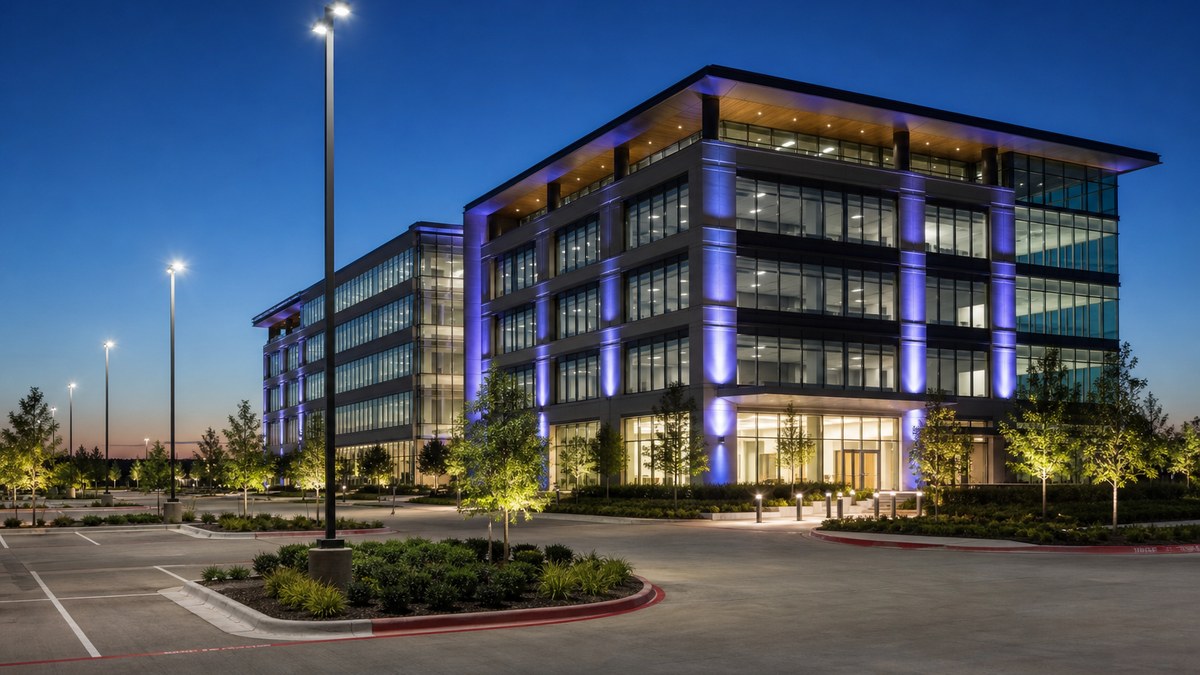
Commercial LED lighting in Frisco, Allen and McKinney is no longer only about swapping old lamps for something more efficient. These three Collin County cities have grown into major business centers in their own right, with corporate offices along the Dallas North Tollway and Sam Rayburn Tollway, retail and restaurant corridors on US-75 and US-380, medical buildings, churches, schools, flex space and new warehouses. Every one of those properties depends on lighting to look professional, keep people safe after dark and keep operating costs under control.
Plano LED Lights is based in Plano and works throughout the northern suburbs. This guide is for building owners, property managers, tenants, facility teams and general contractors in Frisco, Allen and McKinney. It explains what a modern commercial lighting project looks like in each city, which upgrades usually matter most by building type, how lighting controls and energy codes fit in, how permits and utility incentive programs work at a high level, and what to ask before you hire a commercial lighting contractor anywhere in Collin County.
Commercial LED lighting in Frisco, Allen and McKinney combines efficient LED fixtures, lighting controls and good design for offices, retail, restaurants, medical buildings, churches, warehouses and exteriors. A typical project includes:
- Site walkthrough: daytime and, for exteriors, a night visit to document every fixture and problem area
- Design: light levels, color temperature, color quality and glare control matched to the space
- Fixtures: LED retrofit kits, tubes or new fixtures depending on the condition of the existing system
- Controls: occupancy sensors, daylight dimming, schedules and photocells, as required by the code the city enforces
- Permits and incentives: handled per city and per utility program, before work starts
- Installation: phased after hours so the business stays open
- Pricing: a project-specific proposal after the walkthrough
Why Collin County businesses are upgrading now
Frisco, Allen and McKinney share a pattern: a wave of buildings from the 1990s and 2000s that still run on fluorescent troffers, metal halide high-bays and older pole lights, sitting next to brand-new construction designed around LED and networked controls. When those two generations of buildings compete for the same tenants and customers, the older lighting shows.
- Appearance: yellowed lenses, mismatched color temperatures and dark parking lots make a property look dated from the road.
- Maintenance: fluorescent ballasts and metal halide lamps fail regularly, and every lift rental or ladder trip adds cost and disruption.
- Energy use: long operating hours in retail, restaurants, medical and warehouse buildings make lighting one of the most practical places to reduce consumption.
- Safety and security: uniform exterior lighting supports camera coverage and makes employees and customers feel safer after dark.
- Tenant expectations: office and retail tenants increasingly expect flicker-free, comfortable, controllable light.
- Phase-out of older lamp types: fluorescent lamps are becoming harder to source as LED takes over, which pushes many owners to plan an upgrade on their own schedule instead of reacting to failures.
The good news is that most of these upgrades can be done in phases, after hours, without closing the business. The rest of this guide shows what that looks like in each city and building type.
Commercial lighting in Frisco
Frisco has become one of the busiest commercial markets in North Texas. Its business districts cluster along the Dallas North Tollway, the Sam Rayburn Tollway (SH-121) and US-380, with a mix of corporate offices, mixed-use developments, sports and entertainment venues, hotels, restaurants, medical buildings and newer retail centers.
Typical Frisco projects
- Class A and mid-rise offices: lobby and amenity lighting, open-office LED panels or linear fixtures, conference room scenes and garage lighting. Our guides to corporate campus lighting and meeting and conference room lighting apply directly to Frisco offices.
- Mixed-use districts: walkways, plazas, patios, landscape and facade lighting that keeps people outside in the evening and ties the buildings together visually.
- Restaurants and hospitality: warm, dimmable dining light, bar and lounge accent lighting, patio lighting and signature features.
- Sports, training and event venues: high-output, low-glare LED for courts, fields, training facilities and event spaces, plus LED video walls for lobbies and fan areas.
- Newer retail centers: consistent storefront and canopy lighting, parking lot uniformity and controls that dim after closing.
Frisco also has a large share of buildings that are only ten to fifteen years old. Those often have early-generation LED or fluorescent systems that work but look uneven, lack modern controls or use fixtures with poor color quality. In those cases a targeted upgrade, such as new lobby and amenity lighting plus a controls retrofit, can deliver more than a full fixture replacement.
Commercial lighting in Allen
Allen sits along US-75 between Plano and McKinney, and much of its commercial activity runs along that corridor and the major cross streets such as Stacy Road, Bethany Drive, McDermott Drive and Exchange Parkway. The city has a strong mix of regional retail, restaurants, offices, medical buildings, hotels, an events center and growing light-industrial and flex space.
Typical Allen projects
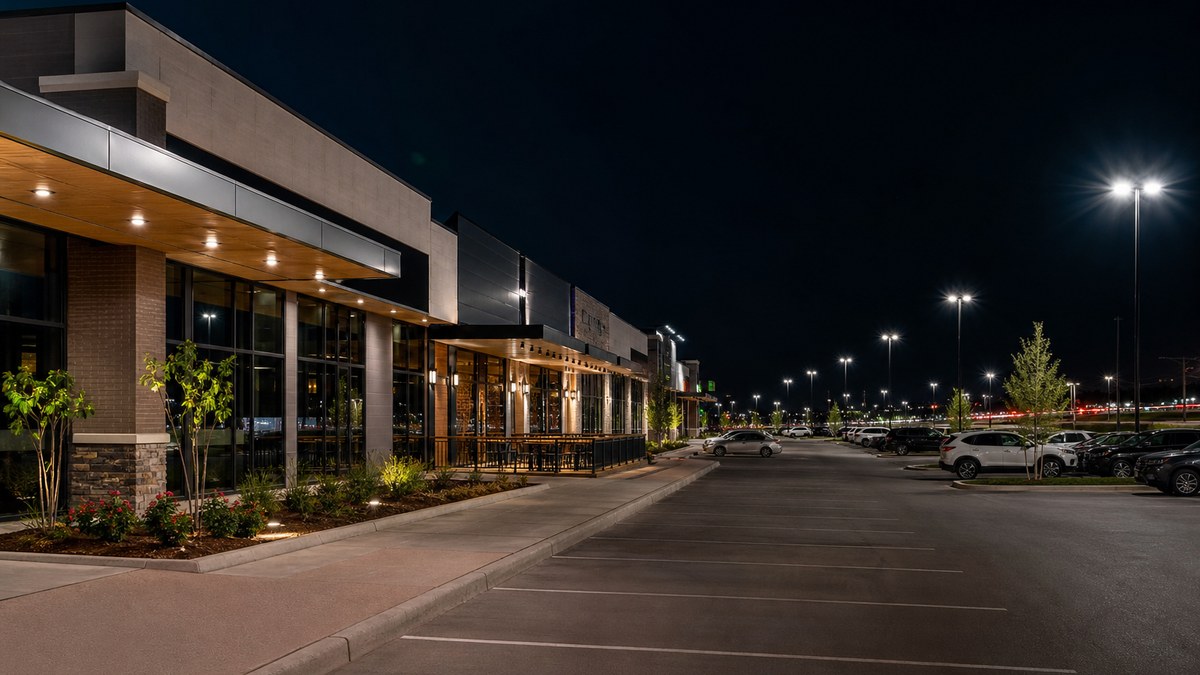
- Retail and shopping centers: storefront lines, canopies, parking lots and tenant interiors. Our shopping center and retail lighting guide covers color quality, layering and center-wide phasing in detail.
- Restaurant pads and outparcels: exterior wall packs, drive-thru and patio lighting, and interior scenes for lunch and dinner service.
- Medical and professional offices: flicker-free, high-color-quality lighting for exam rooms, waiting areas and offices.
- Hotels and event spaces: lobby, ballroom and meeting room lighting with dimming and scene control, plus exterior and parking lighting.
- Flex and light industrial: LED high-bays with sensors in warehouse areas and comfortable office lighting at the front of the building.
Because so much of Allen's commerce is visible from US-75, exterior lighting does a lot of work. A dark parking field or a facade with half its fixtures out is noticed by thousands of drivers a day, and fixing it is often the most visible first phase of a larger project.
Commercial lighting in McKinney
McKinney combines a historic downtown square with fast-growing commercial corridors along US-75, SH-121 and US-380, business parks, an airport-area business district and new industrial development. That range means lighting needs vary more than in almost any other Collin County city.
Typical McKinney projects
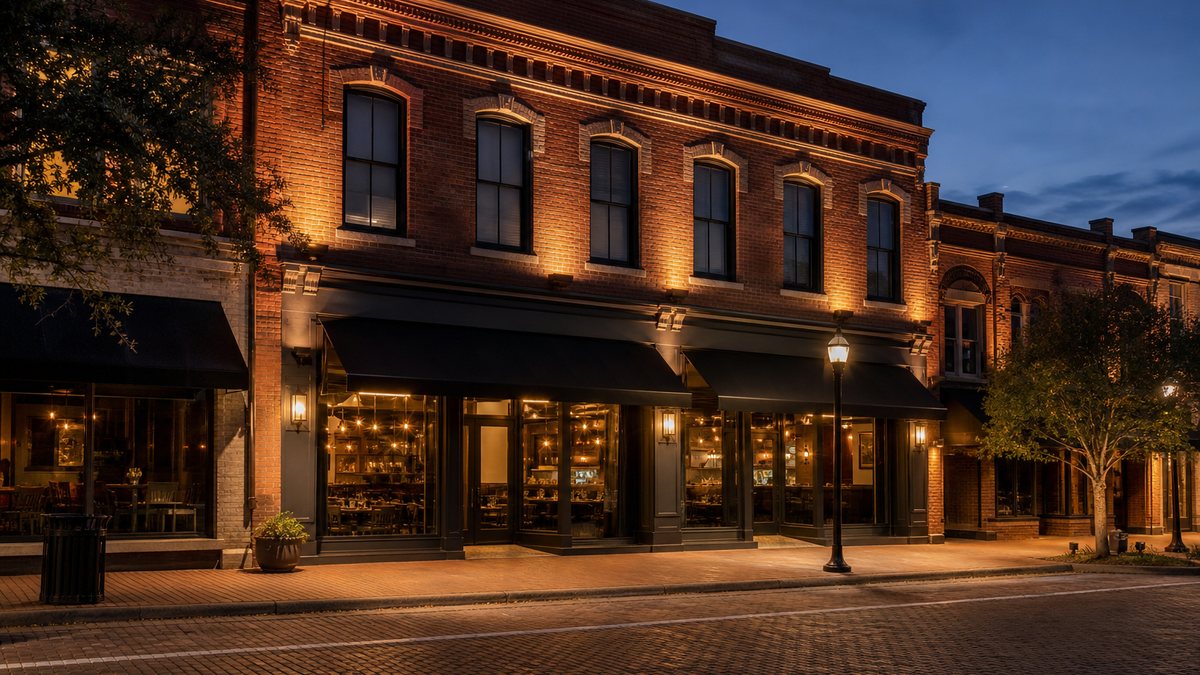
- Historic downtown storefronts and restaurants: warm, sensitive lighting that respects older facades, brick and storefront details while making shops and dining rooms inviting at night. Historic districts may have design review requirements for exterior changes, so check with the city before changing facade or sign lighting.
- Business parks and offices: office retrofits, corridor and stairwell lighting with sensors, and parking lot upgrades.
- Industrial, warehouse and hangar space: LED high-bays with good optics, occupancy and daylight controls, loading dock and yard lighting.
- Retail and medical along the highway corridors: the same storefront, parking and interior needs as Allen and Frisco.
- Churches and schools: sanctuary and worship lighting, gym and multipurpose room lighting, and secure, well-lit parking and walkways.
McKinney's mix of old and new also means a wide range of electrical conditions. Older downtown buildings may need wiring or panel work before new fixtures go in, while newer industrial buildings may only need fixture and controls changes. A walkthrough is the only reliable way to tell the difference.
What to upgrade first: by building type
Every property is different, but some patterns repeat across Frisco, Allen and McKinney. The table below shows where the biggest improvements usually come from.
| Building type | Usually upgraded first | Controls that matter most |
|---|---|---|
| Offices | Open office and corridor fixtures, lobby and amenity spaces, garages | Occupancy and vacancy sensors, daylight dimming near windows, scene control in meeting rooms |
| Retail centers | Canopies, storefront line, parking poles, wall packs | Astronomical time clocks, photocells, dimming after closing |
| Restaurants | Dining room ambience, patio and exterior, kitchen task lighting | Dimming and preset scenes for lunch, dinner and late night |
| Medical and dental | Exam and treatment rooms, waiting areas, corridors | Flicker-free dimming, sensors in restrooms and storage |
| Warehouses and flex | High-bays over racking and open floor, docks, yard lighting | High-bay occupancy sensors, daylight controls near skylights, scheduled exterior lighting |
| Churches and schools | Sanctuaries, gyms, classrooms, parking and walkways | Scene control for services and events, sensors in classrooms and offices |
| Hotels and event spaces | Lobbies, ballrooms, meeting rooms, exterior and parking | Scene control, networked scheduling, after-hours dimming outside |
For more detail on fixture choices, see our guide to LED tubes, retrofit kits or new fixtures, and for controls, our office lighting controls guide.
Retrofit kits, LED tubes or new fixtures?
One of the first decisions in any commercial project is how much of the existing system to keep.
- LED tubes: replace fluorescent lamps in existing fixtures. Fast and low-disruption, but the old housings, lenses and sometimes ballasts stay in place, so appearance and long-term reliability depend on the condition of what is already there.
- Retrofit kits: replace the guts of an existing troffer or high-bay with a new LED engine, driver and lens while reusing the housing in the ceiling. A good middle path for many offices and retail spaces in sound condition.
- New fixtures: the best option when housings are damaged, the layout no longer suits the space, the ceiling is being replaced, or the project needs integrated sensors and better optics. Often the right choice for warehouses, parking lots and full renovations.
Mixing approaches is common. An Allen office might keep sound troffers with retrofit kits in open areas, install new fixtures in the lobby and conference rooms, and replace every pole light in the parking lot. The right mix comes out of the walkthrough, not a catalog.
Planning a lighting upgrade in Collin County?
Tell us about your building and we will follow up to schedule a walkthrough and prepare a project-specific proposal.
Exterior, parking and site lighting
Across all three cities, exterior lighting is where owners most often see the biggest visible change. Older metal halide and high-pressure sodium pole lights create bright pools with dark gaps between them, take time to restart after an outage and shift color as they age.
- Parking lots: LED area lights with optics designed for parking layouts give more even light, reduce dark spots and restart instantly.
- Full-cutoff and shielded fixtures: keep light on the property and off neighboring homes and roads. Many cities regulate exterior light trespass and glare, so fixture selection should follow the local ordinance.
- Wall packs and canopies: consistent color temperature across the building so the property reads as one well-kept site.
- Facade and landscape lighting: grazing and washing on stone, columns and entries, plus tree and landscape lighting for mixed-use and hospitality properties.
- Controls: photocells and astronomical time clocks, plus dimming after hours while keeping security levels.
- Garages: LED garage fixtures with occupancy-based dimming improve visibility and comfort in structured parking.
For a signature look, architectural RGBW lighting on facades and rooflines can mark holidays, events and brand colors without seasonal installs; our guide to permanent commercial holiday lighting explains the options.
Warehouses, flex space and industrial buildings
New distribution and flex buildings continue to rise across Collin County, especially along the major highway corridors and around McKinney and Frisco's northern edges. Older industrial buildings in the area are also being re-tenanted, which is often the right moment to upgrade lighting.
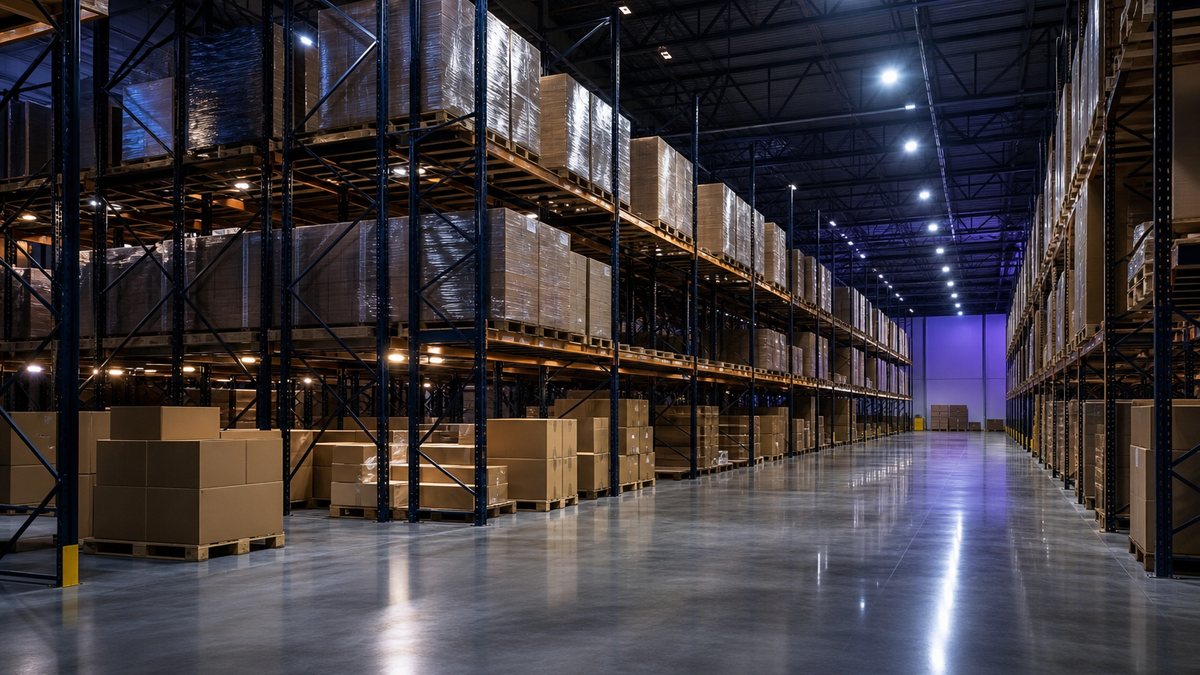
- High-bay optics: narrow optics for aisles between tall racking, wider optics for open floors and staging areas.
- Sensors on every fixture: integrated occupancy sensors dim aisles that are not in use, which matters in large buildings with intermittent traffic.
- Daylight controls: dim fixtures near skylights and clerestory windows when daylight is sufficient.
- Docks and yards: dock lights, wall packs and pole lights for trucks, trailers and safe after-dark loading.
- Office build-outs: front offices and break rooms need comfortable office lighting, not industrial fixtures.
Mounting heights, rack layouts and the condition of existing wiring vary widely, so warehouse projects are always designed after measuring the space. Lift access and working around operations are planned into the schedule.
Energy codes, permits and inspections
Frisco, Allen and McKinney each run their own building permit and inspection process. Each city adopts and enforces its own edition of the commercial energy and electrical codes, sometimes with local amendments, so requirements can differ from city to city and from year to year.
- When permits apply: new fixtures, new circuits, changes to controls, exterior pole replacements and larger alterations generally require an electrical permit and inspection. Simple like-for-like lamp replacement usually does not, but confirm with the city.
- Lighting controls: commercial energy codes typically require occupancy sensing, daylight-responsive controls, automatic shutoff and exterior controls on new installations and many alterations. The exact requirements depend on the code edition the city enforces and the scope of the project.
- Licensed electricians: electrical work in Texas must be performed by properly licensed electricians, and the permit is typically pulled by the licensed contractor.
- Historic and design review: exterior changes in historic districts, such as downtown McKinney, may require additional review.
- Exterior lighting rules: local ordinances may set limits on glare, light trespass, pole heights and sign illumination.
We confirm permit and code requirements with the relevant city during design, so there are no surprises at inspection. For a deeper look at the process, see our guide to commercial LED lighting installation.
Much of Frisco, Allen and McKinney is in the Oncor service area, while some properties, particularly toward the edges of the cities, are served by electric cooperatives. Commercial LED and controls upgrades may qualify for energy-efficiency incentive programs, depending on your utility, the project and current program availability. Most programs require pre-approval before work starts. For buildings that may qualify for the federal 179D deduction, confirm eligibility with your tax advisor.
Lighting quality: what to specify
Not all LED fixtures are equal. The cheapest products often save energy but create glare, flicker, poor color and early failures. For commercial buildings in Collin County, these specifications matter:
| Specification | What it means | Typical guidance |
|---|---|---|
| Color temperature (CCT) | How warm or cool the light looks | 2700K–3000K for restaurants and hospitality, 3000K–3500K for retail and lobbies, 3500K–4000K for offices, 4000K–5000K for warehouses |
| Color rendering (CRI and R9) | How naturally colors appear | 80+ CRI as a minimum for most spaces; 90+ with strong R9 for retail, restaurants, medical and lobbies |
| Glare control (UGR, optics) | Visual comfort at desks, screens and in parking lots | Low-glare lenses in offices; shielded, full-cutoff optics outdoors |
| Flicker | Visible or invisible light modulation | Low-flicker drivers, especially for offices, medical, schools and video recording |
| Dimming protocol | How fixtures talk to controls | 0–10V for most projects; DALI or networked systems for advanced control |
| Listings and ratings | Safety and environment suitability | UL or ETL listed; wet-location ratings outdoors; DLC listing where incentive programs require it |
These are starting points. Brand standards, ceiling heights, finishes and daylight all shape the final design, which is why we often recommend a small mockup before a full rollout in lobbies, retail spaces and restaurants.
How a commercial lighting project runs, step by step
- Consultation: a short call about the building, goals, schedule and any known problems.
- Walkthrough: we document fixture types, quantities, mounting heights, ceiling conditions, controls and electrical concerns. Exterior lighting is checked at night where it matters.
- Design and options: fixture and controls recommendations, with alternatives where they make sense, such as retrofit versus new fixtures.
- Project-specific proposal: a written scope, schedule and price for your building.
- Incentive and permit preparation: utility program applications where available, and permits with the city.
- Mockup (optional): sample fixtures in one area so you can approve the look before the full install.
- Phased installation: after hours, weekends or area by area so the business keeps running.
- Programming and commissioning: sensors, schedules, daylight controls and scenes set up and verified.
- Closeout: fixture schedules, controls settings, warranty documentation and a service plan.
For complete design-build transformations, including architectural lighting, controls and signature features, see our Luminance program.
What drives the cost of a commercial lighting project
Plano LED Lights prices every project individually after a walkthrough. The main factors are:
- Scope: one suite, one floor, a whole building, exterior only, or a multi-building portfolio
- Approach: LED tubes, retrofit kits or new fixtures
- Fixture quality: optics, color quality, finish and driver quality
- Controls: simple sensors and time clocks through networked systems
- Access: ceiling heights, lifts, pole heights, garages and traffic control
- Electrical condition: panels, circuits and underground wiring
- Schedule: after-hours, weekend and phased work
- Permits and design review: city requirements and any historic district review
You receive a written, project-specific proposal before any work begins. For component sourcing, our network also includes wholesale LED components.
How to choose a commercial lighting contractor in Collin County
Searches for "commercial LED lighting near me" return everything from residential electricians to national lighting supply companies. Use these questions to narrow the field:
- Do you design the lighting, or only install what someone else specifies?
- Will you walk the building in person, including a night visit for exterior lighting?
- Who pulls permits in Frisco, Allen or McKinney, and who is the licensed electrician on the job?
- What are the CRI, R9, glare and flicker specifications of the fixtures you propose?
- Which controls are included, who programs them, and how are they commissioned?
- How will installation be phased around our business hours?
- Which fixtures and drivers are specified, and what warranties do the manufacturers provide?
- Who handles service and future changes after the project is complete?
Plano LED Lights brings 15+ years as an authorized architectural lighting dealer and project coordinator. Our licensed installation partner has completed over 200 major sports and commercial projects across the US and Canada — NFL, NBA, NHL, MLS, NCAA and NASCAR. We handle design, supply, installation, programming and service with one accountable team. See our full commercial lighting services, architectural lighting, LED video walls, signage and service and maintenance, or view our service areas.
Frequently Asked Questions
Do you provide commercial LED lighting in Frisco, Allen and McKinney?
Do I need a permit for a commercial lighting upgrade in Frisco, Allen or McKinney?
Are lighting controls required by code?
Should I use LED tubes, retrofit kits or new fixtures?
Can the upgrade be done without closing my business?
Do LED upgrades in Collin County qualify for utility incentives?
What color temperature is best for commercial buildings?
Can you light historic buildings in downtown McKinney?
How much does commercial LED lighting cost in Frisco, Allen or McKinney?
How do I get started?
Better light for your Collin County property
Request a consultation for your Frisco, Allen or McKinney building, or schedule a meeting directly.
Related
More guides on the Plano LED Lights blog, or explore our services.
Our DFW lighting network: Dallas commercial LED lighting, Fort Worth LED lighting, Arlington LED lighting, Irving LED lighting, statewide Texas LED lighting, wholesale LED components, fiber optic starlight ceilings, 360° fiber optic lighting, premium pool lighting, commercial LED signage, modular building solutions, and Dallas modular structures.