Parking Lot & Parking Garage LED Lighting in Plano, TX: Safer Lots, Brighter Decks & Smarter Controls
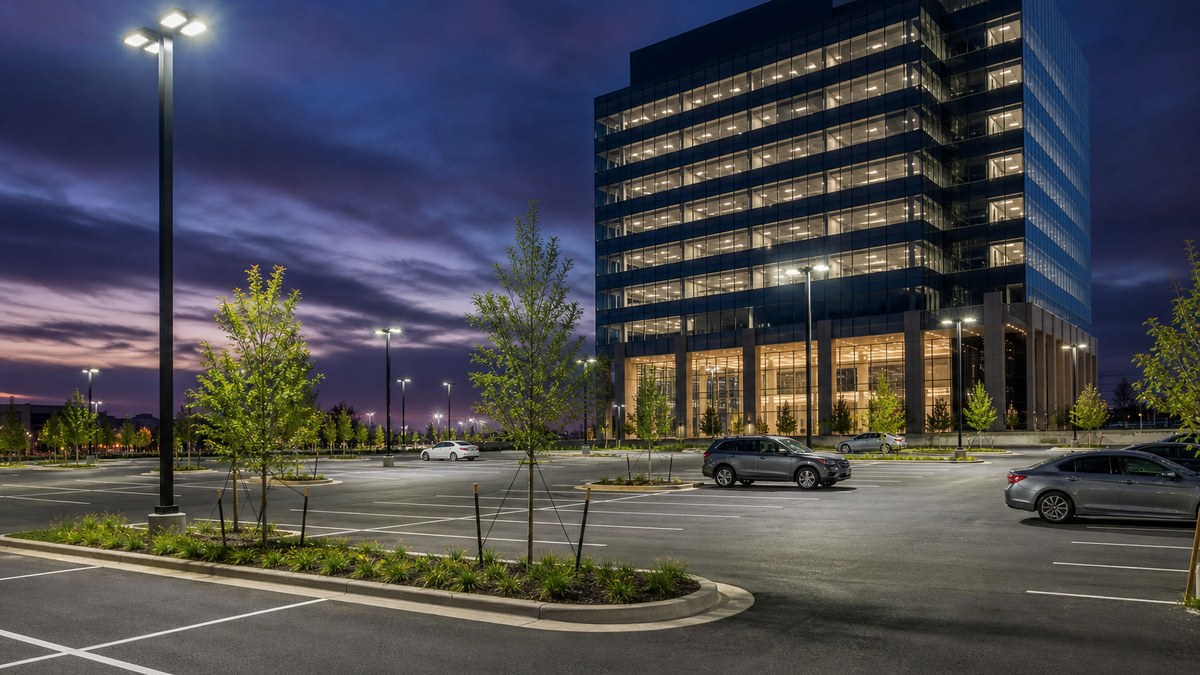
Parking lot and parking garage LED lighting in Plano is the first and last impression of every property. Tenants, shoppers, patients and employees decide how safe a building feels in the few seconds between their car door and the front entrance, and after the clocks change in November that walk happens in the dark for a large part of the business day. A lot with bright pools of light and black gaps between the poles, or a garage deck with flickering, yellowed fixtures, tells people the property is not looked after, no matter how good the lobby is.
This guide is written for property owners, facility managers, HOA and association boards, retail center operators, medical office managers and corporate campus teams in Plano, Legacy, Granite Park and the rest of Collin County. It explains how good parking lighting works, what to look for in LED area lights, wall packs and garage fixtures, how controls and sensors fit in, what codes and neighbors expect, how to phase a project while the lot stays open, and what to ask a lighting contractor before you sign anything.
Modern parking lot and parking garage LED lighting replaces aging metal halide, high-pressure sodium and fluorescent fixtures with LED area lights, wall packs and garage fixtures that put light where people walk and drive, then adds controls so lights dim or brighten based on time and activity.
- Surface lots: full-cutoff LED area lights with optics matched to the pole layout for even, glare-free coverage
- Building perimeter: LED wall packs and canopy lights at entrances, walkways and loading areas
- Parking garages: LED garage fixtures with wide, even distribution, plus brighter entrances that ease the eye's adjustment
- Controls: photocells, astronomical time clocks, occupancy sensors and dimming schedules
- Neighbors and codes: shielded fixtures and controls to limit light trespass and meet the requirements the City of Plano enforces
- Phasing: section-by-section night work so the lot or deck stays usable
- Pricing: a project-specific proposal after a night walkthrough
Why parking lighting deserves real attention
Parking areas are often the largest lit area on a commercial property and the one that gets the least design thought. Fixtures are installed when the building is built, lamps are replaced when someone complains, and over the years the lot drifts into a patchwork of colors and light levels. Upgrading to a planned LED system changes several things at once.
- Safety: even light reveals curbs, wheel stops, potholes and changes in grade, which reduces trip-and-fall risk for people walking to their cars.
- Security: uniform, white light helps people see faces and movement, and it gives security cameras a much better image than dim, orange or patchy light.
- Perception: a well-lit lot signals that a property is open, managed and worth visiting, which matters for retail centers, restaurants and medical offices competing for evening traffic.
- Liability and complaints: owners and managers hear about dark corners first from tenants. Fixing them proactively is easier than responding to an incident.
- Maintenance: tall poles and garage ceilings are expensive places to change lamps. Long-life LED fixtures with quality drivers sharply reduce lift trips and service calls.
- Energy and control: parking lights run every night of the year. Efficient fixtures paired with dimming and sensors make a meaningful difference in operating costs, which we quantify per site in our proposal rather than with generic estimates.
In Plano the stakes are higher because so many properties share busy corridors. Office campuses along the Dallas North Tollway and around Legacy, medical buildings near the hospital districts, neighborhood centers on Preston Road, Coit Road and Park Boulevard, and mixed-use districts with structured parking all compete for tenants who notice how a property feels at night.
How good parking lot lighting actually works
Good parking lighting is not simply about brightness. A lot can be very bright under each pole and still feel unsafe if the space between poles is dark. Lighting designers focus on a few measurable qualities.
Uniformity over raw brightness
Uniformity describes how even the light is across the lot, usually expressed as a ratio between the brightest and darkest points. Human eyes adapt to the brightest light they see, so a lot with hot spots makes the dark gaps look even darker. Modern LED area lights use precise optics to spread light toward the edges of each pole's coverage area, so the whole lot reads as evenly lit. The Illuminating Engineering Society publishes recommended practices for parking facilities (ANSI/IES RP-8), and a professional photometric layout uses those recommendations as a starting point.
Vertical light, not only light on the pavement
Light that hits people and car doors at face height matters as much as light on the ground. Vertical illumination is what lets someone recognize a person walking toward them and what makes camera footage useful. Pole placement, mounting height and optic choice all affect it.
Glare control
Older fixtures, especially drop-lens and unshielded floodlights, throw light sideways into drivers' eyes. Glare reduces visibility instead of improving it. Full-cutoff, flat-lens LED fixtures direct light downward, and house-side shields can stop light from spilling where it is not wanted.
BUG ratings
Many outdoor LED fixtures carry a BUG rating, which describes backlight, uplight and glare. Lower numbers mean less light going behind the fixture, into the sky and toward viewers' eyes. BUG ratings are a practical way to compare fixtures and to show a city reviewer or a neighboring property that a design is controlled.
Color temperature and color rendering
Most commercial parking areas use 3000K to 4000K LED. Warmer 3000K light feels softer next to residential neighborhoods and restaurants, while 4000K reads crisper for offices, medical buildings and garages. Compared with the orange glow of high-pressure sodium, either option renders colors far better, so people can identify vehicles and clothing. The right choice depends on the property, its neighbors and any standards the owner or the city expects.
| Older source | Common problems | LED replacement approach |
|---|---|---|
| Metal halide pole heads | Long warm-up and restrike after outages, color shift and fading with age, frequent lamp changes | LED area lights with matched optics, instant on, dimmable drivers |
| High-pressure sodium | Orange light, poor color rendering, weak camera images | 3000K–4000K LED with much better color rendering |
| Drop-lens or flood fixtures | Glare, light trespass onto neighbors and streets | Full-cutoff, flat-lens fixtures with shields where needed |
| Fluorescent garage fixtures | Poor performance in cold weather, flicker, lamp breakage, dim corners | Sealed LED garage fixtures with wide distribution and sensors |
| Old wall packs | Glare at doors, burned-out units, mismatched colors | Full-cutoff LED wall packs with photocells |
LED fixtures for surface parking lots
Most surface lots in Plano are lit by pole-mounted area lights, with wall packs on the building and sometimes bollards or low-level lights along walkways. Each has a role.
Area lights and shoebox fixtures
Pole-mounted LED area lights are the workhorse of parking lighting. Different optical distributions throw light in different patterns: some push light forward toward the lot from a perimeter pole, others spread it in all directions from a pole in the middle of a row. Choosing the right distribution for each pole is what turns a set of fixtures into an even lot. Many fixtures also offer field-adjustable output, so a contractor can fine-tune levels after installation instead of over-lighting the whole site.
Retrofit kits vs complete new fixtures
When existing poles and bases are sound, owners often ask whether to install retrofit kits inside existing heads or replace the heads entirely. Retrofit kits can work when the housings are in good condition, but complete new fixtures usually deliver better optics, sealing, heat management and appearance. We cover the trade-offs in detail in our guide to light fixture installation and replacement in Plano.
Poles, bases and wiring
LED fixtures are lighter than many old metal halide heads, but poles and concrete bases still need to be checked. Rust at the base, damaged hand-hole covers, loose anchor bolts and aging underground wiring are common in older lots. A good upgrade includes an inspection so those issues are fixed during the same mobilization.
Walkways, entrances and landscape areas
The path from the parking stall to the door matters most. Crosswalks, accessible routes, ramps, stairs and building entrances usually deserve brighter, more even light than the drive aisles. Bollards, step lights and canopy downlights make these routes obvious and comfortable without adding glare.
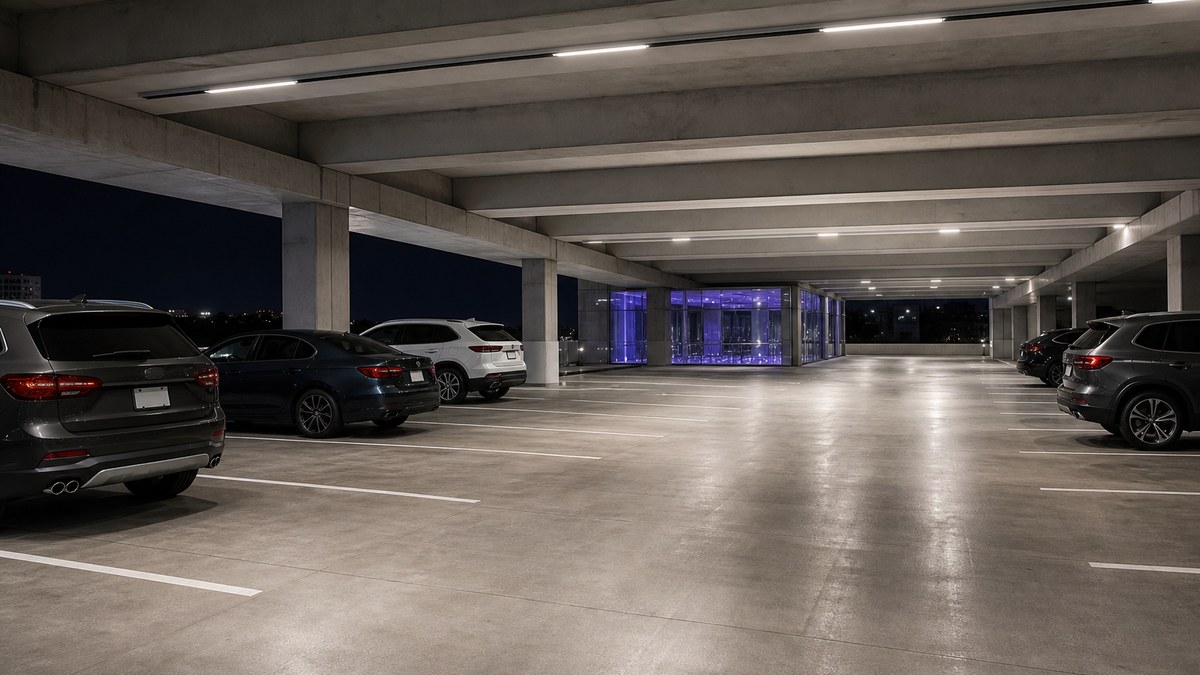
Parking garage LED lighting
Structured parking is common around Legacy, Granite Park, corporate campuses, hospitals and mixed-use districts across Plano. Garages have very different lighting needs from surface lots, and they often run lights every hour of every day.
Low ceilings and wide distribution
Garage ceilings are low and full of beams, sprinkler pipes and ducts. LED garage fixtures are designed with wide, flat distributions that spread light sideways across drive aisles and stalls, with some light reaching up to brighten the ceiling. A brighter ceiling makes the whole deck feel more open and reduces the cave-like feeling that keeps people from parking on upper or lower levels.
Entrances and daylight transitions
Drivers coming in from bright Texas sun need time for their eyes to adjust. Garage entrances are usually lit more brightly during the day so drivers are not suddenly blinded by darkness, then dimmed at night. The U.S. Department of Energy's parking structure lighting guidance discusses this transition zone, and current commercial energy codes generally require daylight-responsive controls near large openings in garages.
Stairwells, elevator lobbies and pay stations
These are the places people wait and the places they feel most vulnerable. Bright, even, comfortable light, along with lighting that stays on at safe levels whenever the garage is open, is essential. Emergency and egress lighting must be maintained here as well.
Durability
Garages are dusty, damp and exposed to vehicle exhaust, pressure washing and temperature swings. Fixtures should be rated for wet or damp locations as appropriate, with sealed housings, corrosion-resistant finishes and drivers protected against electrical surges.
Walk every level at night and during the day with a simple checklist: dark stalls, burned-out fixtures, flicker, glare at entrances and how bright the stairwells feel. That walk usually shows whether the garage needs targeted repairs or a full LED upgrade with sensors.
Lighting controls for lots and garages
LED fixtures are naturally easy to control. They turn on instantly, dim smoothly and handle frequent switching far better than metal halide or sodium lamps. That makes controls one of the most valuable parts of a parking lighting upgrade.
| Control | Where it fits | What it does |
|---|---|---|
| Photocells | Pole lights, wall packs, canopies | Turn lights on at dusk and off at dawn based on real daylight and storm darkness |
| Astronomical time clocks | Site-wide lighting panels | Follow sunrise and sunset through the year and schedule after-hours dimming |
| Fixture-mounted occupancy sensors | Lots after closing, garages, perimeter walkways | Raise light when people or vehicles are present and dim when areas are empty |
| Daylight sensors | Garage perimeter rows and entrances | Reduce output when daylight through openings is sufficient |
| Scheduled dimming | Retail centers, offices, medical buildings | Lower levels after business hours while keeping security light |
| Networked or wireless controls | Campuses, large centers, multi-site portfolios | Central scheduling, zoning, fault reporting and energy monitoring |
Controls should be designed around how a property is actually used. A restaurant lot needs full light until the last staff member leaves. An office campus may dim most of its surface lot after evening hours but keep walkways and garage stairwells bright. A retail center may want different schedules for tenant-facing rows and back-of-house service drives. For a deeper look at sensors, daylight dimming and networked systems, see our guide to office lighting controls in Plano and DFW.
Dark spots in your lot or garage?
Tell us about your property and we will follow up to schedule a night walkthrough and a project-specific proposal.
Codes, neighbors and light trespass
Many Plano commercial properties sit right next to neighborhoods, schools and parks. Light that spills into backyards and bedroom windows creates complaints, and older fixtures are a common cause. A good LED design addresses this from the start.
- Local requirements: outdoor lighting on commercial sites is subject to the zoning and development requirements the City of Plano enforces, which can cover shielding, fixture heights and light at property lines. Requirements depend on the site and the scope of work, so we confirm them during design.
- Energy code: new installations and major alterations generally need to meet the commercial energy code edition the City of Plano enforces, including exterior lighting power limits and automatic controls such as dusk-to-dawn switching and after-hours reduction.
- Shielding and optics: full-cutoff fixtures, careful aiming and house-side shields keep light on your property.
- Pole height and placement: sometimes the right answer is a different optic or a lower mounting height rather than more fixtures.
- Permits: some projects, especially those that add poles, change circuits or alter the site plan, require permits and inspections. Your contractor should tell you up front.
A photometric plan is the best tool for both code review and neighbor concerns. It shows predicted light levels across the lot and at property lines before any fixture is ordered.
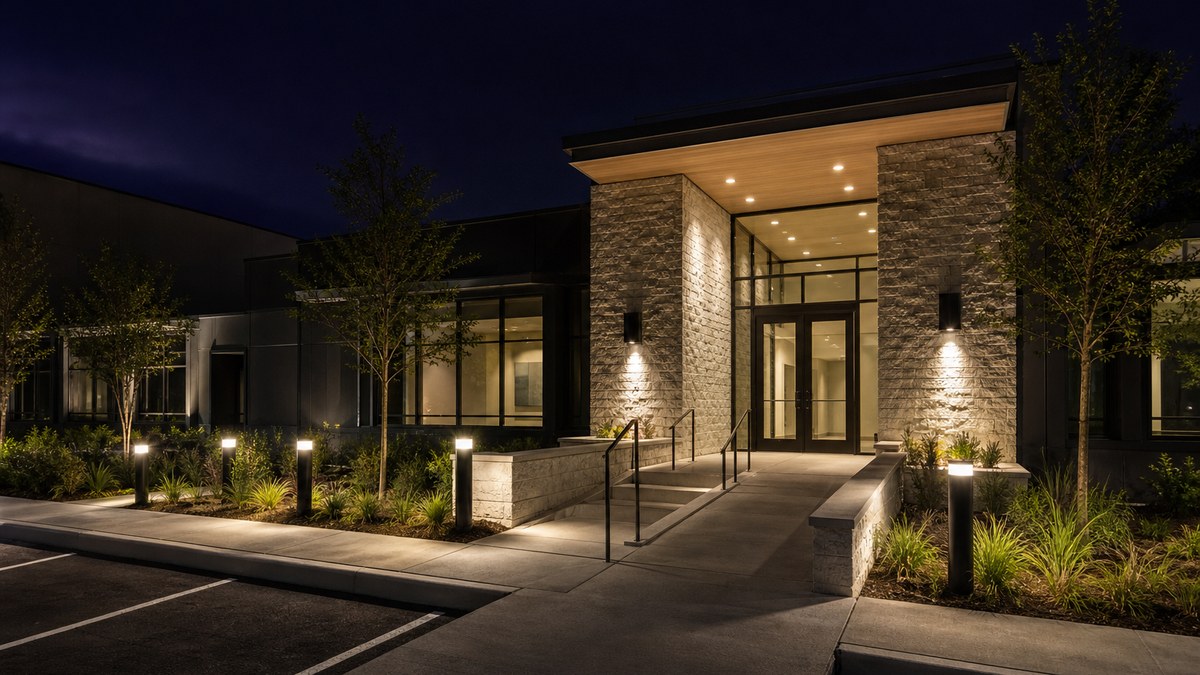
Parking lighting by property type
Office buildings and corporate campuses
Offices need safe paths for people who leave late, well-lit garage stairwells and entrances, and controls that dim large lots after hours. Campuses around Legacy and Granite Park often combine surface lots, structured parking and landscaped walkways, so a consistent fixture family and color temperature across the property pays off. Our corporate campus lighting guide covers lobbies, offices and grounds in more detail.
Shopping centers and retail strips
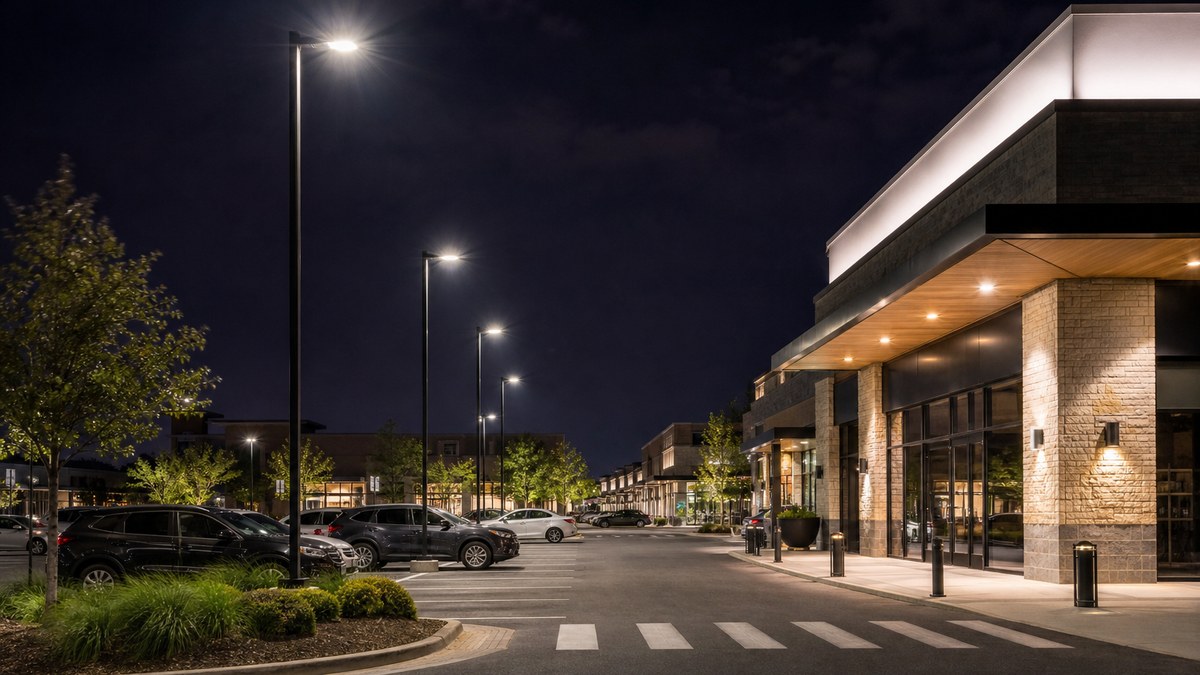
Retail lots must look inviting from the road and feel safe at closing time. Even pole lighting, well-lit storefront canopies and bright entrances do the heavy lifting. See our shopping center and retail LED lighting guide for storefronts and center-wide upgrades.
Restaurants and entertainment
Restaurants run late and depend on evening traffic. Warm, glare-free light that complements patio and facade lighting keeps the site welcoming, while sensors can dim back rows once the dinner rush ends.
Medical and dental offices
Patients arrive early in the morning and after work, often unfamiliar with the building. Clear wayfinding light, bright accessible routes and covered drop-off areas make visits easier.
Warehouses, flex space and industrial sites
Truck courts, docks, yards and employee parking each need different light. Wall packs and pole lights should be sized to the work being done. Our warehouse and flex space LED lighting guide covers docks and yards.
Churches, schools and community facilities
These lots may be empty most nights and packed for events. Occupancy sensors and scheduled scenes let them deliver full light during services, games and meetings without lighting an empty lot all night.
Multifamily and HOA common areas
Residents expect safe parking and walkways right outside their homes, but they also notice glare and light through their windows. Warm color temperatures, shielded fixtures and careful layouts are especially important.
Planning a parking lighting upgrade step by step
A parking lighting project can usually be completed while the lot or garage stays open. Here is how a professional project typically runs.
- Night walkthrough: we visit after dark to see the property the way your tenants and visitors do, noting dark areas, glare, failures, color mismatches and pole condition.
- Inventory: every pole, head, wall pack, canopy light and garage fixture is documented with mounting heights, circuits and controls.
- Goals: we agree on priorities such as safety, camera coverage, appearance, neighbor concerns and how lights should behave after hours.
- Photometric layout: fixtures and optics are modeled so you can see expected light levels before anything is ordered.
- Proposal: a written, project-specific proposal with fixture schedules, controls and phasing.
- Incentive check: commercial LED upgrades in the Oncor service area may qualify for energy-efficiency incentive programs, depending on the project and program availability. Most programs require approval before work starts. For tax questions such as 179D, confirm with your tax advisor.
- Phased installation: lots are done in sections with lifts and traffic control; garages are done level by level, usually during low-traffic hours.
- Commissioning: photocells, schedules, sensors and dimming are set and then verified at night.
- Documentation and service: fixture schedules, control settings and manufacturer warranty information are handed over, along with a service plan.
Owner, tenant or association?
Before planning a project, confirm who owns and maintains the parking lighting. In most multi-tenant properties the landlord or association controls the lots, garages, poles and site wiring, while tenants control lights mounted on their own storefronts. In single-tenant net leases, the tenant may be responsible. In shared parking arrangements, several owners may need to agree on standards. Getting this clear early avoids delays and makes sure the whole property ends up consistent.
What affects the cost of parking lighting projects
We do not publish price lists because no two lots or garages are alike. Every project is quoted individually after a walkthrough. The main factors are:
- Number and height of poles and whether existing poles and bases can be reused
- Retrofit kits vs complete new fixtures, and the optics and quality level specified
- Garage size and layout, including levels, ceiling obstructions and stairwells
- Controls, from photocells and time clocks to fixture sensors and networked systems
- Electrical condition, including underground wiring, panels and code corrections
- Access and traffic control, including lifts, lane closures and night work
- Permits and photometric design where required
You receive a written, project-specific proposal before work starts. For sourcing, our network also includes wholesale LED components.
Questions to ask before you hire
- Will you visit the property at night before proposing fixtures?
- Will you provide a photometric layout showing light levels and uniformity?
- What BUG ratings, optics and color temperatures are you specifying, and why?
- How will you limit light trespass onto neighboring properties?
- Which controls are included, and who programs and verifies them?
- How will installation be phased so the lot or garage stays open?
- Will you inspect poles, bases and wiring as part of the work?
- Which fixtures and drivers are specified, and what manufacturer warranties apply?
- Who handles service after the project is complete?
Plano LED Lights brings 15+ years as an authorized architectural lighting dealer and project coordinator. Our licensed installation partner has completed over 200 major sports and commercial projects across the US and Canada — NFL, NBA, NHL, MLS, NCAA and NASCAR. We handle design, supply, installation, programming and service with one accountable team. Learn more about our commercial lighting services, our service and maintenance, the full Luminance design-build program, or how a professional project runs in our commercial LED installation guide. Properties outside Plano are covered in our Frisco, Allen and McKinney guide, and you can see all the cities we serve on our service areas section.
Frequently Asked Questions
What is the best lighting for a commercial parking lot?
Is it worth replacing metal halide or sodium parking lot lights with LED?
Can I keep my existing parking lot poles?
What color temperature should parking lot lights be?
How should a parking garage be lit?
Do parking lot lights need to be on all night?
How do I stop parking lot lights from shining into nearby homes?
Can a parking lot or garage stay open during an LED upgrade?
Are there incentives for LED parking lighting in Plano?
How much does parking lot or garage LED lighting cost?
Make your parking areas feel safe after dark
Request a consultation and we will follow up to schedule a night walkthrough of your lot or garage. Prefer to talk first? Schedule a call.
Related
Our DFW lighting network: Dallas commercial LED lighting, Fort Worth LED lighting, Arlington LED lighting, Irving LED lighting, statewide Texas LED lighting, wholesale LED components, fiber optic starlight ceilings, 360° fiber optic lighting, premium pool lighting, modular building solutions, Dallas modular structures, and LED signs and pylon signage.