Storefront Window & Canopy LED Lighting in Plano, TX: Window Displays, Entry Canopies, Canopy Signs & After-Dark Curb Appeal
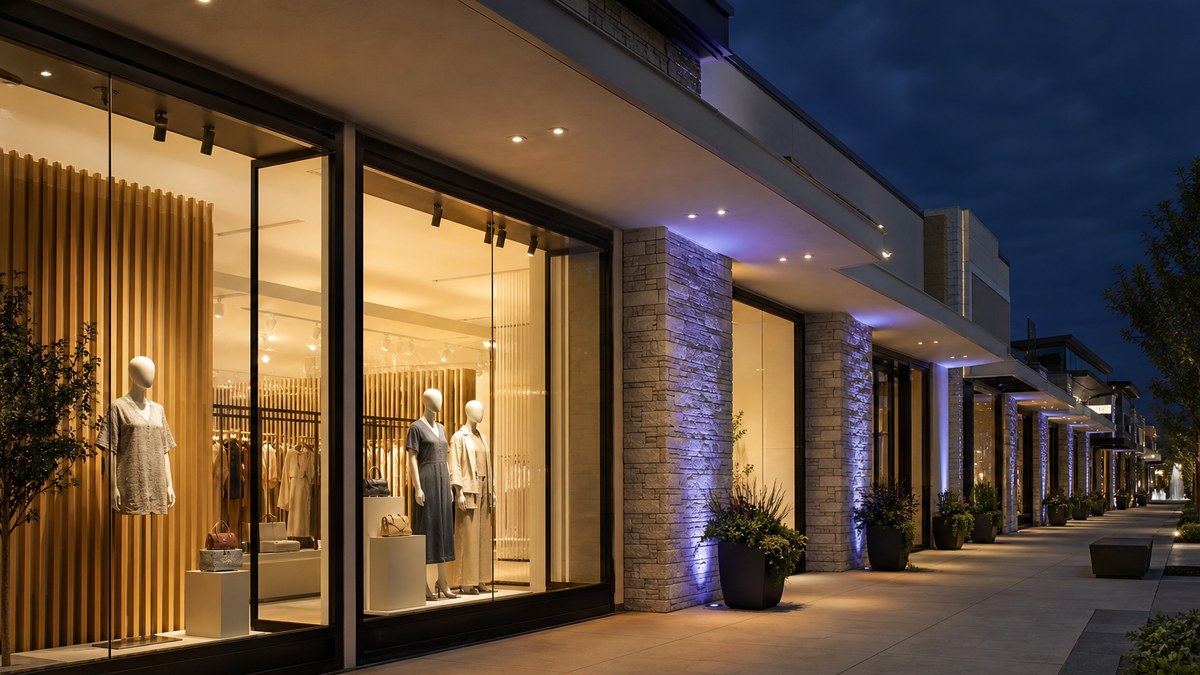
Storefront window and canopy LED lighting in Plano is the part of a business that customers see first and judge fastest. Before anyone reads your sign or opens the door, the glow of the display window, the light under the entry canopy and the brightness of the storefront line tell them whether you are open, whether the space feels safe and whether the brand looks premium or tired. On busy corridors like Preston Road, Park Boulevard, Spring Creek Parkway and the Dallas North Tollway, and in walkable districts like Legacy and Downtown Plano, that impression is made in a few seconds from a moving car or a sidewalk.
This guide is written for retail tenants, restaurant and service operators, shopping center owners and property managers in Plano and Collin County. It answers the questions we hear most: who actually puts LEDs in business windows, which LED solutions work best for storefronts, how to light a display window so it reads in daylight and at night, how to light entry canopies, drive-thru canopies and canopy signs, which controls keep it all running on time, and how to plan the work without closing the store.
The best storefront lighting combines adjustable, high-CRI LED accent lighting inside the display window, even and glare-free LED downlights under canopies and soffits, properly lit canopy signs and facade details, and automatic controls that switch everything with sunset and closing time.
- Who installs it: a commercial lighting contractor for display, canopy and facade lighting; a sign company for channel letters and LED window signs; ideally one coordinated team
- Display windows: LED track or recessed adjustable accent fixtures with 90+ CRI, aimed to avoid glare toward the street
- Daytime vs night: windows need more light during the day to beat glass reflections and less after dark
- Canopies: low-profile, wet- or damp-rated LED canopy fixtures with consistent color across every bay
- Canopy signs: sign lighting coordinated with canopy and facade light so neither washes out the other
- Controls: astronomical time clocks, photocells and separate circuits for windows, canopies and signs
- Pricing: a project-specific proposal after a walkthrough, ideally at night
Why storefront lighting matters so much in Plano
Plano shoppers and diners have choices on almost every corner. Newer mixed-use districts around Legacy and Granite Park set a high bar for how a storefront should look after dark, and neighborhood and strip centers along the major arterials compete with them for the same customers. Lighting is one of the most visible and least disruptive ways for an older storefront to close that gap.
- It signals "open": a dark window or a canopy with burned-out fixtures reads as closed, even when the lights are on inside.
- It sells before the door opens: a well-lit window display is advertising that works every evening, including after closing.
- It shapes perceived quality: mismatched color temperatures, flicker and glare make even a high-end brand look neglected.
- It supports safety: well-lit entries, sidewalks and canopies help customers and staff feel comfortable and support camera coverage.
- It keeps a center consistent: when every storefront and canopy matches, the whole property looks well managed, which matters for leasing.
Storefront lighting is also where interior and exterior lighting meet, and where responsibilities between landlord, tenant and sign company overlap. That is why it is so often done piecemeal, and why a coordinated plan makes such a visible difference. For the bigger picture on retail properties, see our shopping center and retail LED lighting guide.
Who puts LEDs in business windows?
It is one of the most common questions business owners search, and the answer depends on what kind of window lighting you mean:
- Display and merchandise lighting inside the window: a commercial lighting contractor or lighting designer, working with a licensed electrician, specifies and installs track, recessed and linear fixtures and the circuits and controls that run them.
- Outlining, mullion and architectural accent lighting: also a commercial lighting contractor. Linear LED in window frames, soffits and reveals needs careful detailing so the source is hidden and the color stays consistent.
- LED window signs, open signs and neon-style LED graphics: usually a sign company, and larger or permanent signs may need a sign permit under City of Plano rules.
- Window-facing digital displays and LED video: a display integrator. High-brightness displays behind glass have their own requirements, covered in our LED video wall buyer's guide.
- Seasonal and holiday window lighting: often a decorating vendor, though many businesses now prefer permanent, programmable LED. See our commercial holiday lighting guide.
The problems usually start when each of these is handled by a different vendor at a different time. The sign ends up brighter than the window, the canopy lights clash in color with the facade, and nobody owns the time clock. Plano LED Lights coordinates the lighting side of the storefront as one project and works alongside your sign company or our partners at American LED Signage so the whole frontage is planned together.
Lighting the display window: the fundamentals
A display window is a small stage. Like a stage, it needs light that is aimed, controlled and hidden, not a ceiling of flat panels. These are the principles we use on storefront windows across Plano and Collin County.
1. Accent light, not just general light
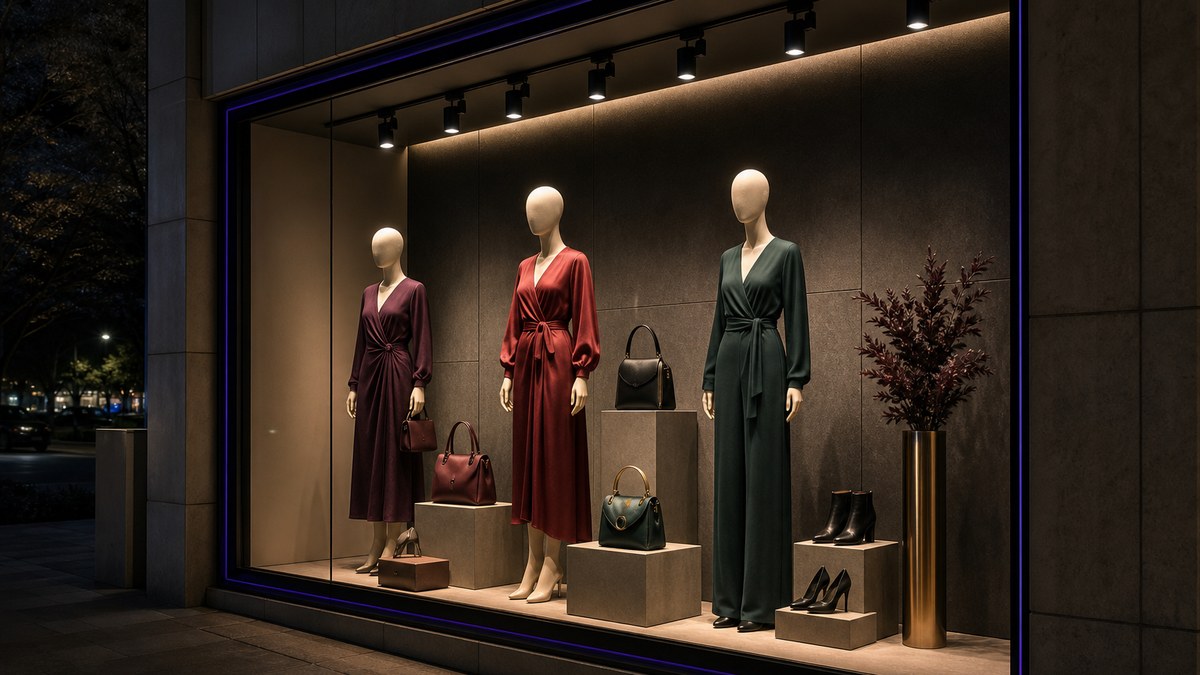
Merchandise in a window should be clearly brighter than its surroundings. Adjustable LED track heads or recessed adjustable fixtures let merchandisers re-aim light every time the display changes. A mix of beam spreads helps: narrow spots for a single product or mannequin, medium floods for a group, and wall-washing or linear light for backdrops and graphics.
2. Color quality you can see from the sidewalk
Color rendering matters even more in a window than on the sales floor, because customers decide from a distance whether a product looks appealing. Most storefront displays benefit from 90+ CRI fixtures with a strong R9 (saturated red) value. Fashion, jewelry, cosmetics, furniture and food often justify the highest-rendering fixtures available. Color temperature should match the brand and the interior, typically warm to neutral white, and every fixture in the window should come from tight color bins so the display does not show mismatched tints.
3. Aim to avoid glare toward the street
Fixtures aimed too steeply or placed too close to the glass shine straight into the eyes of people outside. Mount accent fixtures inside the window ceiling, set back from the glass, and aim them down and away from the street toward the merchandise. Snoots, louvers and honeycomb baffles control spill and hide bright LED sources from view.
4. Win the battle with daylight reflections
During the day the biggest enemy of a display window is the reflection of the bright street, sky and parking lot on the glass. If the display is dimmer than the reflected scene, shoppers see the parking lot instead of your products. The fix is more light on the display during daylight hours, darker backdrops that reduce contrast with reflections, awnings or canopies that shade the glass, and in some cases anti-reflective or low-reflection glazing. After dark the situation reverses, and the same window needs much less light to look bright.
5. Keep heat and fading in check
LED fixtures put far less heat into the beam than older halogen and metal halide display lamps, and quality LEDs emit very little ultraviolet. That is gentler on merchandise, signage and graphics, although strong sunlight through the glass remains a major cause of fading, so window film and shading still matter.
| Window condition | Lighting goal | Practical approach |
|---|---|---|
| Bright afternoon sun on the glass | Overcome reflections so products are visible | Highest accent output, darker backdrop, shading from canopy or awning |
| Overcast day | Balanced display that still stands out | Daytime scene at reduced output, daylight sensor if available |
| Dusk and early evening | Peak visibility to drivers and walkers | Evening scene, facade and canopy lights on with sunset |
| After closing | Advertise and support security without waste | Lower "after-hours" scene on a schedule, then off or dimmed overnight |
| Display change or event | Highlight new merchandise or a promotion | Re-aimed heads, optional color-tunable or RGBW accent for themes |
The best energy-efficient LED solutions for storefronts
Another question Plano businesses search is which LED solutions are most efficient for storefronts. Efficiency comes from choosing the right fixture for each job and then controlling it well, not from simply buying the brightest lamp.
- LED track and adjustable recessed accent fixtures for display windows, with interchangeable optics so you light the product instead of the floor.
- Linear LED in shelves, reveals and window frames to outline displays and architecture with a hidden source.
- Low-profile LED canopy and soffit downlights to replace older recessed cans, compact fluorescent and metal halide canopy fixtures.
- LED wall washers and grazers on facades, columns and stone to give the storefront depth without floodlight glare.
- LED sign lighting in channel letters, cabinet signs and canopy fascias, coordinated with the rest of the frontage.
- LED wall packs and entry lights with full-cutoff optics at doors, side entrances and service areas.
- Controls on every layer: astronomical time clocks, photocells, dimming and separate circuits so windows, canopies and signs each run on the right schedule.
Many commercial LED upgrades in the Oncor service area may qualify for energy-efficiency incentive programs, depending on the project and current program availability. Most programs require approval before work starts, so the incentive check belongs at the beginning of the project, not the end.
Entry canopies, soffits and covered walkways
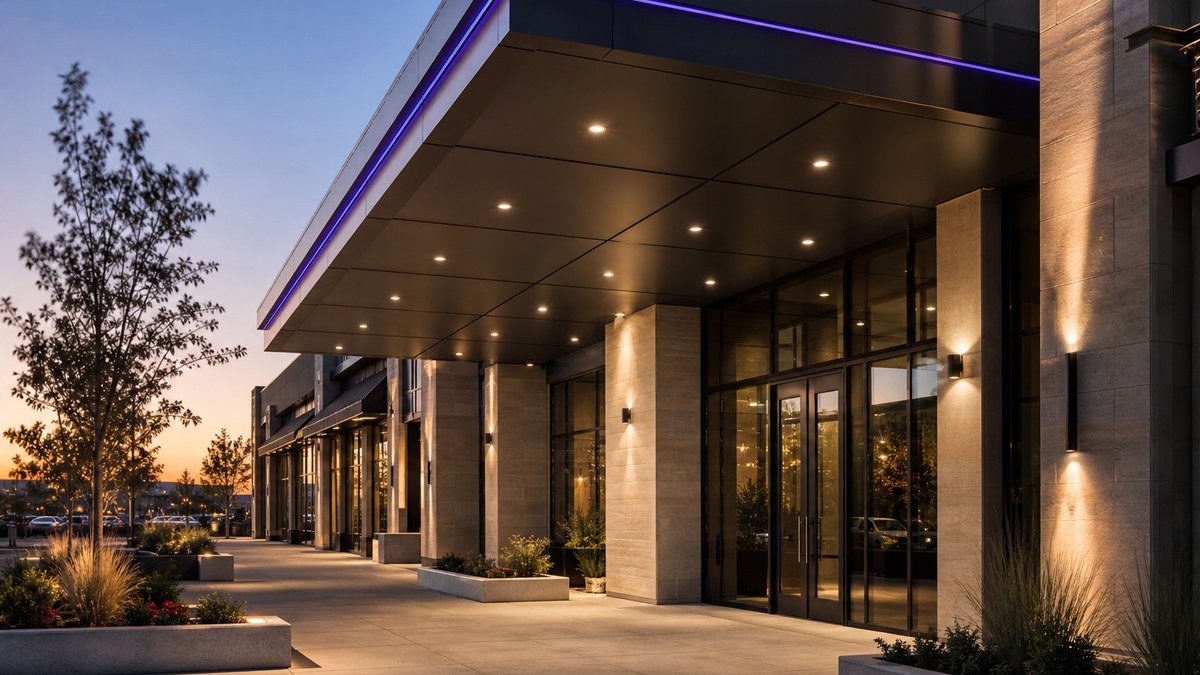
In most Plano shopping centers, office buildings and restaurants, the canopy or soffit over the entrance is the most-seen piece of exterior lighting on the property. It frames the door, lights the sidewalk and sits directly under the sign. It is also where older properties show their age first: a row of mismatched fixtures, a few dark bays, yellowed lenses full of insects and a mix of warm and cool light.
- Consistency across every bay: one fixture type, one color temperature and one output level so the whole storefront line reads as a single property.
- Low-profile, sealed fixtures: flat or slightly recessed LED canopy lights stay clean longer and are less of a target for insects and debris.
- Correct ratings: damp- or wet-rated fixtures depending on exposure, with finishes suited to North Texas heat, storms and humidity.
- Glare control: lenses and optics that light the sidewalk and the entrance without shining into drivers' eyes or competing with the sign.
- Vertical light at the entrance: light on the storefront, door and faces, not only on the pavement, so entrances feel welcoming and cameras see clearly.
- Covered walkways and breezeways: even, comfortable light that connects storefronts and parking, especially where employees walk to their cars after closing.
For many neighborhood centers, replacing canopy and soffit lighting along the whole storefront line is the single biggest visual upgrade available, and it can be done from the outside without entering a single tenant space. For fixture-by-fixture options, including retrofit kits versus new fixtures, see our guide to light fixture installation and replacement in Plano.
Walk your storefront line after sunset with a phone camera. Photograph every dark bay, every fixture that looks a different color, every sign that looks brighter or dimmer than its neighbors and every spot where glare hides the window. That five-minute walk is the best possible start to a storefront lighting project, and it is the first thing we do on a walkthrough.
Drive-thru, pickup and service canopies
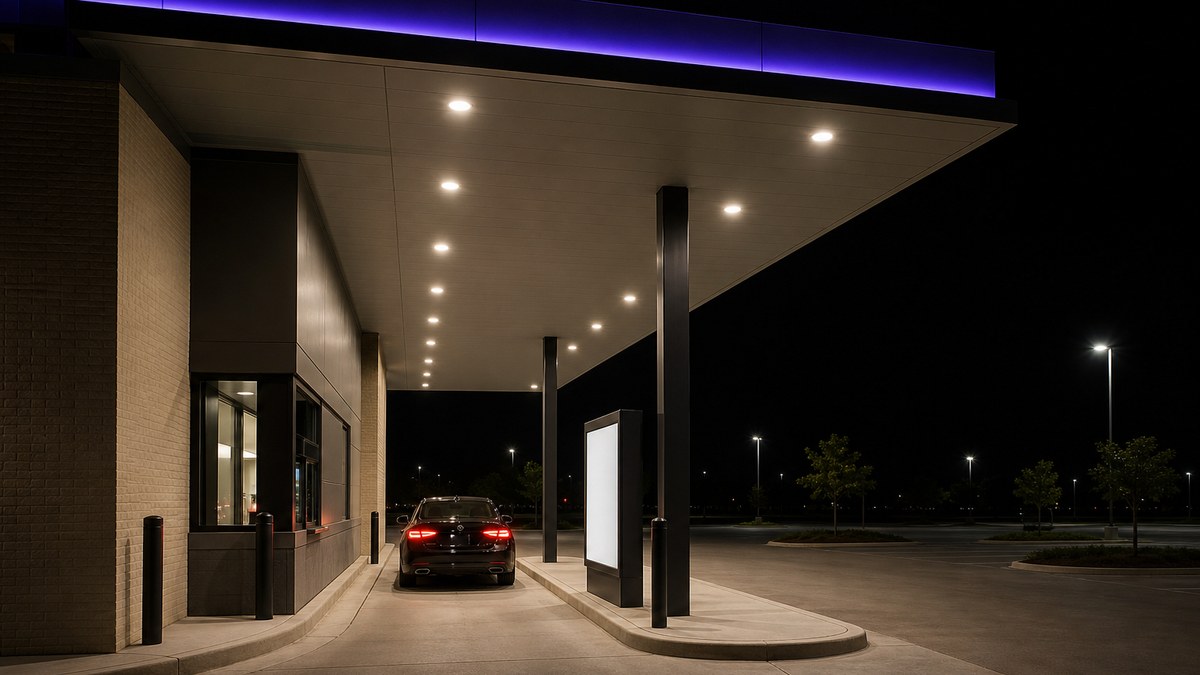
Many Plano businesses now have a canopy that does more than shelter an entrance: drive-thru lanes, curbside and mobile-order pickup bays, porte-cocheres at hotels and offices, and covered service areas at automotive and fuel sites. These canopies are working spaces, often used around the clock.
- Uniform light over every lane and bay so staff can read orders, check vehicles and hand off items comfortably.
- Higher vertical light at service windows and menu boards to make faces, payment terminals and menus easy to see.
- Fixtures designed for the canopy deck, mounted to suit the structure and sealed against dust, insects and wind-driven rain.
- Controlled spill so canopy light stays under the canopy instead of spilling onto neighboring homes or roads.
- Coordination with signage and digital menu boards so screens are readable and not washed out by overhead light.
- Overnight controls that dim lanes that close earlier and keep security levels where operations continue.
Canopy lighting connects naturally to the parking lot and site lighting beyond it. Our parking lot and garage LED lighting guide covers poles, uniformity and dark-sky friendly optics in more detail.
Want your storefront to stand out after dark?
Tell us about your storefront, canopy or center and we will follow up to schedule a walkthrough and a project-specific proposal.
Canopy signs, facades and the storefront line
Signage and lighting are designed by different trades but seen as one picture. When they are planned separately, a bright sign can make the window behind it look dark, or bright canopy light can wash out an illuminated letter set. A good storefront plan balances all of them.
Canopy and fascia signs
Channel letters and logo signs mounted on a canopy fascia, and illuminated canopy bands, should be readable from the road without overpowering the storefront. Matching color temperature and brightness between neighboring tenants keeps a center looking unified. For sign fabrication, channel letters, monument signs and message centers, our network partner American LED Signage works alongside our lighting scope, and sign permits are handled under City of Plano sign rules.
Facade washing and grazing
Grazing light across stone, brick or textured panels, and washing columns, towers and parapets, gives a storefront depth at night and helps it stand out from flat, unlit neighbors. LED wall washers and linear grazers with tight optics put light on the building instead of the sky. See our architectural lighting services for more.
Linear outlines and accent details
Hidden linear LED in window mullions, reveals, soffit edges and rooflines can outline a storefront with a clean, modern line. Static white works year-round; RGBW or color-tunable systems on programmable controls let a business mark holidays, events and promotions without new fixtures.
Window-facing screens
Digital displays and LED video in or behind storefront glass are increasingly common in Plano retail and restaurants. They need enough brightness to read in daylight, a dimming schedule for night, and placement that does not fight the display lighting. They may also be treated as signage, so check the City of Plano sign rules and any landlord criteria before installing.
| Storefront zone | Recommended LED approach | Typical control |
|---|---|---|
| Display window | Adjustable track or recessed accent, 90+ CRI, glare-controlled optics | Day, evening and after-hours scenes on a time clock |
| Entry canopy and soffit | Low-profile sealed downlights, one color temperature across all bays | Astronomical time clock or photocell |
| Drive-thru and pickup canopy | Uniform canopy fixtures with strong vertical light at service points | Schedule by lane hours, dimming overnight |
| Canopy and fascia signs | LED sign modules matched to facade brightness and color | Separate sign circuit and schedule |
| Facade and columns | Wall washers and grazers with tight optics | Dusk-to-set-time schedule, optional scenes |
| Outlines and accents | Hidden linear LED, static white or RGBW | Programmable controller for seasons and events |
| Doors and side entrances | Full-cutoff wall packs and entry lights | Photocell, dusk to dawn |
Controls that keep the storefront on schedule
Storefront lighting fails most often not because a fixture breaks, but because nobody adjusts the time clock after a power outage or daylight saving time. The result is a window that is dark at dusk or a canopy that burns all day. Good controls solve that.
- Astronomical time clocks calculate sunset and sunrise for Plano automatically and adjust through the year.
- Photocells respond to real conditions, including dark storm afternoons.
- Separate circuits for display windows, canopies, signs and facades let each one run on its own schedule.
- Scenes and dimming give windows a brighter daytime setting, an evening setting and a lower after-hours setting.
- Networked or app-based control lets multi-location operators and property managers change schedules and spot outages remotely.
Commercial energy codes generally require automatic shutoff and separate control of display, accent and exterior lighting on new installations and significant alterations. The exact requirements depend on the code edition the City of Plano enforces and the scope of work, so they should be confirmed during design. For a deeper dive into sensors, schedules and networked systems, read our lighting controls guide for Plano and DFW.
Storefront lighting by business type
Fashion, jewelry and specialty retail
Contrast and color quality do the selling. Lower general light, carefully aimed high-CRI spots on featured pieces, and a window that is re-aimed with every display change. Jewelry windows benefit from a mix of tight beams for sparkle and softer fill for the case.
Restaurants, cafés and bars
The storefront should show warmth and activity inside: warm-white light on the dining room visible from the street, a glowing bar, lit patio edges and a welcoming entry canopy. Our restaurant and patio lighting guide covers dining rooms, bars and patios in depth.
Salons, studios, clinics and service businesses
These storefronts often have less merchandise to display, so the job is to make the space look open, clean and inviting. Even, flattering interior light visible through the glass, a lit logo wall and a bright, consistent canopy usually do more than heavy window displays.
Showrooms and furniture
Large windows benefit from residential-feeling warm light, lit room vignettes and wall washing that shows depth. The daytime reflection problem is often greatest here, so shading and a strong daytime scene matter.
Banks, offices and ground-floor commercial
Ground-floor offices in mixed-use buildings want a professional, secure look after hours: a lit lobby or reception visible from the street, a softly lit facade and well-lit entries. Our corporate campus lighting guide for Legacy and Granite Park covers larger office properties.
Owner vs tenant: who handles what?
Storefront lighting sits right on the line between landlord and tenant responsibilities, so it helps to sort that out early.
- Owner / landlord: typically canopies, soffits, covered walkways, facade and architectural lighting, parking and site lighting, and center-wide pylon or monument signs.
- Tenant: typically display windows, interior lighting visible through the glass, the tenant's own building and canopy signs, and any window graphics or screens.
- Tenant design criteria: many Plano centers and mixed-use districts have written criteria for storefront lighting, sign style, color temperature and hours. Tenants should get approval before installing.
When an owner upgrades canopy and facade lighting, offering tenants the same standards and the same contractor for their windows keeps the center consistent and simplifies scheduling. We work with owners, property managers, tenants, brokers and general contractors on both sides of the lease. For an overview of all our commercial services, see our business lighting services in Plano page.
Planning a storefront upgrade without closing
- Night walkthrough: document every window, canopy fixture, sign and facade light, plus glare, dark spots and color mismatches.
- Daytime check: look at the windows in afternoon sun to judge reflections and shading.
- Goals and criteria: agree on color temperature, brightness balance, fixture appearance, hours and any landlord or tenant criteria.
- Mockup: install sample fixtures in one window or one canopy bay so decision-makers see the result first.
- Incentive check: confirm whether the project may qualify for Oncor programs, depending on program availability, before work starts.
- Project-specific proposal: fixtures, controls, phasing and coordination with the sign company in one written scope.
- After-hours installation: canopy and facade work at night or early morning; window work after closing or between displays.
- Commissioning: set scenes and schedules, aim every display fixture, then verify at night from the street and the parking lot.
- Documentation and service: fixture schedules, control settings and a service plan so the storefront stays consistent.
For a closer look at what a professional commercial lighting project involves from walkthrough to commissioning, see our guide to commercial LED lighting installation in Plano.
Storefront lighting around Plano and Collin County
Each part of the area has its own storefront character:
- Legacy and Granite Park: mixed-use streets with ground-floor retail and restaurants under offices and residences, where storefronts are seen by pedestrians as much as drivers and consistency is expected.
- Downtown Plano: historic storefronts along 15th Street, where warm, carefully hidden lighting respects the architecture.
- Preston Road, Park Boulevard, Coit Road and Spring Creek Parkway: neighborhood and strip centers where canopy and storefront line upgrades make older properties competitive.
- Frisco, Allen and McKinney: fast-growing retail corridors and historic squares with similar needs. See our Frisco, Allen and McKinney commercial LED guide.
- Highland Park and Park Cities: luxury retail where display lighting and color quality are part of the brand. See our Highland Park business lighting guide.
We serve all of these areas and the wider metroplex; see our service areas.
What drives the cost of storefront and canopy lighting
Storefronts vary widely, so every project is priced individually after a walkthrough. The main factors are:
- Scope: one display window, a single storefront, a full canopy line or a whole center
- Retrofit vs new fixtures: reusing existing canopy housings and circuits or replacing them
- Fixture quality: color rendering, optics, glare control and outdoor ratings
- Controls: simple time clocks through scenes and networked control
- Access: canopy height and construction, lifts, sidewalks and traffic around entrances and drive-thrus
- Electrical condition: aging wiring, shared circuits and code items found during the work
- Coordination: signage, landlord criteria, permits and after-hours scheduling
You receive a written, project-specific proposal before work begins. For sourcing, our network also includes wholesale LED components.
Questions to ask before you hire
- Will you look at the storefront both at night and in daylight?
- What CRI, R9 and color consistency do the display fixtures have?
- How will you control glare toward the street and the parking lot?
- Are the canopy fixtures rated for the location, and how are they sealed?
- How will the lighting be coordinated with our signs and any window screens?
- What controls are included, and who programs and documents them?
- Can we see a mockup before the full installation?
- How will the work be scheduled around our business hours?
- Who handles service and adjustments after the project is finished?
Plano LED Lights brings 15+ years as an authorized architectural lighting dealer and project coordinator. Our licensed installation partner has completed over 200 major sports and commercial projects across the US and Canada — NFL, NBA, NHL, MLS, NCAA and NASCAR. We handle design, supply, installation, programming and service with one accountable team. Learn more about our retail and storefront lighting services, our signage lighting, the full service list, and complete design-build projects through the Luminance program. You can also browse more guides on the Plano LED Lights blog, including our commercial LED lighting guide for Plano.
Frequently Asked Questions
Who puts LEDs in business windows?
What are the best energy-efficient LED solutions for storefronts?
How do you light a storefront window display?
Why does my window display disappear during the day?
What color temperature is best for storefront lighting?
What kind of lights go under a storefront canopy?
Should store window lights stay on after closing?
Do I need a permit for storefront or canopy sign lighting in Plano?
Do storefront LED upgrades qualify for incentives in Plano?
How much does storefront and canopy lighting cost?
Light up your storefront the right way
Request a consultation and we will follow up to schedule a night walkthrough of your storefront, canopy or center. Prefer to talk first? Schedule a meeting.
Related
Our DFW lighting network: Dallas commercial LED lighting, Fort Worth LED lighting, Arlington LED lighting, Irving LED lighting, statewide Texas LED lighting, wholesale LED components, fiber optic starlight ceilings, 360° fiber optic lighting, premium pool lighting, modular building solutions, Dallas modular structures, and American LED Signage.